How to Crochet a Simple Border on a Baby Blanket
A flat single crochet border in two or three rounds, with stitch ratios for the row-end sides, corners that lie flat, checked stitch counts and fixes for ruffling and cupping.
Tutorial at a glance
Materials
- About 60-100 yd (55-91 m) of yarn for three rounds on a 30 x 35 in (76 x 89 cm) blanket, an estimate that depends on gauge
- Crochet hook used for the blanket
- 4 stitch markers
- Blunt yarn needle
- Scissors
A simple border on a baby blanket does two jobs: it covers the uneven row ends along the sides, and it gives all four edges the same finish. Two or three rounds of single crochet are enough.
This pattern uses US crochet terms. It fits any rectangular blanket worked in rows, whatever its size, because the stitch counts come from the blanket itself.
Materials
- Yarn in the same weight as the blanket. For three rounds on a 30 x 35 in (76 x 89 cm) blanket in worsted weight (#4 medium), allow about 60-100 yd (55-91 m). This is an estimate that depends on your gauge, so keep a little extra from the same dye lot.
- The hook used for the blanket, for example US H-8 (5 mm).
- 4 stitch markers, one for each corner.
- Blunt yarn needle and scissors.
For color, a border in one of the blanket’s own colors blends in and hides small irregularities. A contrasting color frames the blanket and shows every stitch, so it asks for more even work.
Finished Size
In worsted weight yarn, each round of single crochet adds roughly 1/4 in (0.6 cm) to every edge. Three rounds add about 1.5 in (3.8 cm) to the width and to the length. If the final measurement matters, plan the body smaller, as shown in the baby blanket size chart.
Gauge
A border has no gauge of its own. The target is stitches the same width as those of the blanket body, so the border lies flat. Matching that tension matters for the size of the border and for the amount of yarn it uses.
Abbreviations
- ch = chain
- sc = single crochet
- hdc = half double crochet
- sl st = slip stitch
- st(s) = stitch(es)
Pattern Notes
- Work in rounds with the right side of the blanket facing you. Do not turn at the end of a round.
- The ch 1 at the start of each round does not count as a stitch.
- Each corner is 3 sc worked into one stitch. Place a marker in the middle sc of the three and move it up every round.
- Each round has 8 more stitches than the round before, 2 at each corner.
Where the Stitches Go
Along the top edge, work 1 sc in each stitch of the last row. Along the bottom edge, work 1 sc in each chain of the starting chain, into the loops left free by the first row.
The two sides are row ends, and they have no ready-made stitches. The usual guidance is to space the border stitches by the height of the blanket’s stitch:
- Single crochet rows: 1 sc in the end of each row.
- Half double crochet rows: about 3 sc for every 2 rows.
- Double crochet rows: about 2 sc in the end of each row.
These ratios are a starting point. Put the same number of stitches on both sides.
An example: a blanket 105 sts wide with 88 rows of half double crochet gets 105 sts along the top, 105 along the bottom, and 88 / 2 x 3 = 132 sc along each side.
Instructions
Round 1: With the right side facing, join the yarn with a sl st in any stitch of the top edge a few stitches away from a corner. Ch 1, sc in the same st and in each st to the last st of the top edge, 3 sc in the last st. Sc evenly down the first side at the ratio for your stitch. 3 sc in the first ch of the bottom edge, sc in each ch to the last ch, 3 sc in the last ch. Sc evenly up the second side. 3 sc in the first st of the top edge, sc in each remaining st to the start. Join with a sl st in the first sc.
In the example, the first and last stitch of the top and bottom edges are the corners. That leaves 103 plain stitches on each of those edges: 103 + 103 + 132 + 132 + 12 corner stitches = 482 sc.
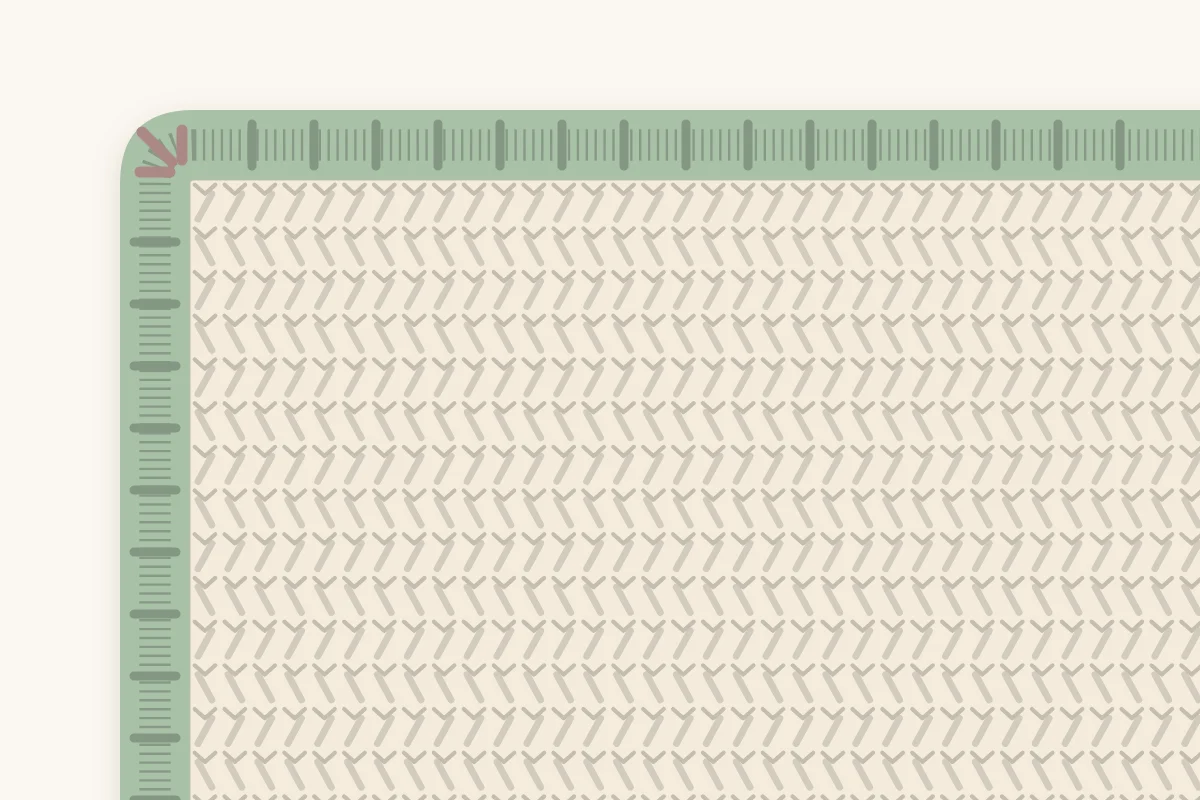
Round 2: Ch 1, do not turn. Sc in the same st as the join and in each st around, working 3 sc in the marked middle st of each corner. Join with a sl st in the first sc. The example now has 482 + 8 = 490 sc.
Round 3: Repeat Round 2. The example has 498 sc. Fasten off.
Optional Variations
A half double crochet round. For a slightly deeper border, work Round 2 in hdc: ch 1 (does not count as a stitch), hdc in the same st as the join and in each st around, with 3 hdc in the marked st of each corner. Join with a sl st in the first hdc. The stitch count is the same as for the sc round.
A chain corner. In place of 3 sc, work (sc, ch 2, sc) in each corner. On later rounds, work (sc, ch 2, sc) into the ch-2 space. This makes a sharper, squarer corner, and the count of sc still grows by 8 per round.
Fixing Ruffles and Cupping
Lay the blanket flat on a table after Round 1 and look along each edge before you continue.
- The edge ruffles or waves. It has too many stitches. This nearly always happens on the row-end sides. Pull the round back and space the stitches further apart, for example 4 sc over 3 rows where you had 3 over 2.
- The edge cups or pulls the blanket inward. It has too few stitches, or the stitches are too tight. Add stitches along the sides, or go up one hook size.
- The corners curl up. They need more room. Check that each corner has all 3 stitches in one stitch.
A wavy border is one of the common baby blanket mistakes, and it rarely blocks out completely.
Finishing
Cut the yarn, leaving a tail of about 6 in (15 cm), and pull it through the last loop. Weave the tail into the back of the border stitches in more than one direction. The guide to weaving in ends shows a path that holds through repeated washing.
A light blocking helps the corners sit square. See how to block a crochet blanket, and follow the care instructions on the yarn label.
This border stays flat and close to the fabric, with nothing added to it. It also works as the base round for a scalloped shell edging.
Frequently asked questions
Do I need to weave in the blanket's ends before adding a border?
It is the tidier order. Weave in the tails from the body first so they are locked into the fabric, then work the border. Some crocheters lay short tails along the edge and crochet over them, but a tail that is woven in with a needle as well is held more firmly.
Which side of the blanket should face me while I work the border?
The right side, meaning the side you want to show. For a blanket worked in turned rows both faces look much alike, so choose one, mark it with a stitch marker, and keep it facing you for every round. Changing sides between rounds changes the look of the stitches.
Can I add a border to a blanket made of granny squares?
Yes. The same rounds work once the squares are joined. Place one stitch in each stitch and in each chain space along the edges, treat the seams between squares consistently, and work three stitches in each outer corner space. Check after the first round that the edge lies flat.