Warm Winter Baby Blanket Pattern in Bulky Yarn
A thick, ribbed baby blanket pattern in bulky yarn using back-loop half double crochet, with a gauge target, the chain arithmetic written out and one repeating row of 75 stitches.
Tutorial at a glance
Materials
- Bulky weight (#5 bulky) yarn, about 600-750 yd
- US K-10.5 (6.5 mm) crochet hook
- Large-eye blunt yarn needle
- Scissors
- Tape measure
- One stitch marker
Thick yarn and a close stitch are what make a warm winter baby blanket feel substantial in the hand. This pattern uses bulky yarn and half double crochet worked in the back loop only, which leaves a raised ridge across every row. The fabric is dense and ribbed on both sides.
There is one stitch and one repeating row, so the pattern suits a beginner who has already tried a plain half double crochet blanket. It is written in US crochet terms.
Why Bulky Yarn and a Dense Stitch Make a Thicker Blanket
Bulky yarn (#5) is a clear step thicker than the worsted weight used for most first blankets, and the fabric can never be thinner than the strand it is made from. Half double crochet is a short stitch with an extra wrap of yarn in it, so the rows pack closely with only small gaps between stitches. Working into the back loop adds a ridge on top of that, which gives the fabric more depth than plain rows.
The trade-offs are worth knowing before you buy yarn:
- Weight. A bulky blanket is noticeably heavier than a worsted one of the same size.
- Stiffness. Thick, dense fabric drapes less. Check the swatch for flexibility as well as size.
- Yarn by weight. You need fewer yards than in a thinner yarn, but more ounces, and bulky skeins hold fewer yards each.
- Fewer stitches. A row here is 75 stitches, compared with about 105 in a typical worsted blanket of the same width.
Watch out
This site covers crochet technique only. The American Academy of Pediatrics advises keeping loose blankets and other soft bedding out of an infant’s sleep space; for questions about using a blanket with a baby, follow your pediatrician’s guidance.
Materials
- Bulky weight (#5 bulky) yarn, about 600-750 yd (550-690 m)
- US K-10.5 (6.5 mm) crochet hook
- Large-eye blunt yarn needle
- Scissors and a tape measure
- One stitch marker
The yarn amount is an estimate that depends on your gauge and the yarn’s construction, so buy a little extra from the same dye lot. The guide to how much yarn a baby blanket needs shows how to work out a closer figure from your own swatch.
Finished Size
About 30 x 36 in (76 x 91 cm) before any border.
Gauge
10 hdc and 8 rows = 4 in (10 cm) in the back-loop pattern. Matching this target matters for the finished size and for the amount of yarn you use.
For a swatch, chain 16 and work the pattern for 12 rows. That gives 15 stitches, a piece about 6 in (15 cm) square. Lay it flat without stretching the ribs and measure in the middle. Too many stitches in 4 in means a larger hook, and too few means a smaller one. The article on crochet gauge for blankets explains the measuring step.
The chain count comes straight from the gauge. Ten stitches in 4 in is 2.5 stitches per inch, and 2.5 x 30 in = 75 stitches. Add 1 chain for the turn: 76 chains. For the length, 8 rows in 4 in is 2 rows per inch, and 2 x 36 in = 72 rows.
Abbreviations
- ch – chain
- hdc – half double crochet: yarn over, insert hook, yarn over and pull up a loop, yarn over and pull through all 3 loops on the hook
- BLO – back loop only
- st(s) – stitch(es)
- yo – yarn over
Pattern Notes
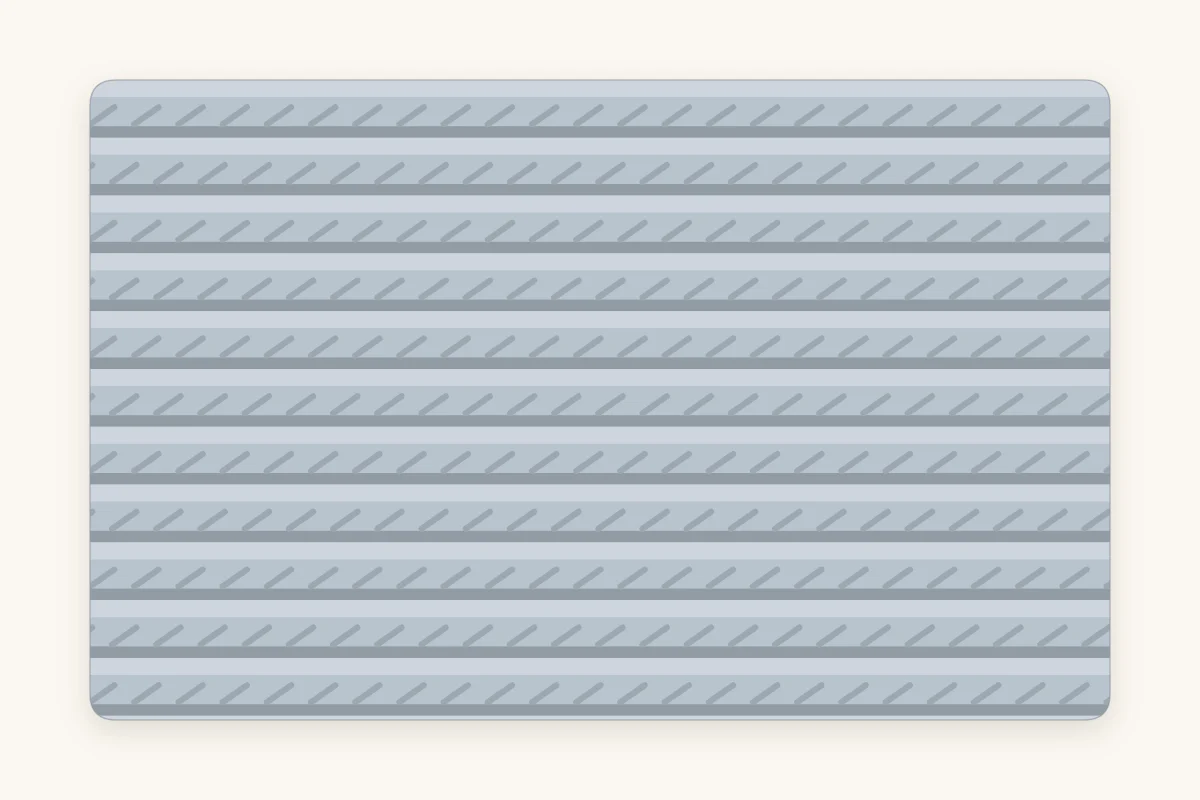
- Finding the back loop. Look down at the top edge of a row. Each stitch ends in two strands that form a sideways V. The strand nearer to you is the front loop, and the one farther from you is the back loop. For a BLO stitch, slide the hook under the far strand alone.
- Half double crochet also has a third strand, a horizontal bar just below the back loop on the side facing away from you. This pattern does not use it.
- The turning ch-1 does not count as a stitch. The first stitch of each row goes into the very first stitch, at the base of the chain.
- The first and last stitch of every row are worked under both loops. This keeps the side edges firm and straight, and it does not change the count.
- Every row has 75 stitches. Any number of stitches works, so for another width multiply your stitches per inch by the width you want and add 1 chain.
Instructions
Chain 76. Keep the chain relaxed, because a tight chain in bulky yarn pulls the bottom edge in visibly.
Row 1: Hdc in the 2nd ch from the hook and in each ch across. (75 hdc)
Row 2: Ch 1, turn. Hdc under both loops of the first st. Hdc in BLO of each of the next 73 sts. Hdc under both loops of the last st. (75 hdc)
Rows 3-72: Repeat Row 2, or continue until the piece measures about 36 in (91 cm).
Fasten off, leaving an 8 in (20 cm) tail.
Check the Count on the Swatch
The swatch follows the same logic on 15 stitches. Chain 16, skip the first chain, and work one half double crochet in each of the remaining 15 chains. On Row 2, chain 1 and turn, then work 1 stitch under both loops, 13 in the back loop and 1 under both loops: 1 + 13 + 1 = 15. Row 3 is identical. On the blanket the same sum is 1 + 73 + 1 = 75.
Tip
Place the stitch marker in the first stitch of each row as soon as you make it. On the next row that marked stitch is the last one, and it is easy to overlook beside the turning chain.
Finishing
Bulky tails need more room than thin ones. Run each tail through the base of the stitches along a row for about 3 in (8 cm), turn and come back through neighboring strands, then make a short third pass before trimming. See how to weave in ends for the full method.
The ribbed fabric lies flat without help, so a border is optional. If you add one, a single round of single crochet in the same yarn is enough: one stitch in each stitch along the top and bottom, about 3 stitches for every 2 row ends along the sides, and 3 stitches in each corner. The steps are in the article on a simple blanket border. Wash the blanket as the care label directs, and check for loose ends afterward.
Frequently asked questions
What is the difference between back loop only and third loop half double crochet?
Both leave a ridge, but they use different strands. Back loop only goes under the far strand of the V on top of the stitch. Third loop, sometimes called camel stitch, goes under the horizontal bar below that V and pushes the whole V forward. The two look different, so pick one and use it for every row.
Why does my bulky blanket feel stiff?
The stitches are probably too tight for the yarn. Dense fabric in thick yarn has little room to bend, so even a small drop in hook size shows. Try a swatch with a hook one size larger and compare how the two pieces fold. A larger hook also changes the gauge, so recalculate the starting chain.
Can I use two strands of worsted yarn instead of bulky yarn?
Two strands held together give a thickness in the bulky range, but the result varies from yarn to yarn. Swatch with both strands, measure the gauge, and work out the chain from your own numbers. You will need about twice the yardage listed, since each stitch uses both strands.