Crochet Gauge for Blankets: How to Measure and Why It Matters
Learn what crochet gauge is, how to make and measure a swatch before and after washing, how to correct gauge with hook size, and the simple formula that turns gauge into a chain count.
Tutorial at a glance
Materials
- The yarn chosen for the blanket
- The hook you plan to use, plus one size up and one size down
- Rigid ruler or tape measure
- Two pins or removable stitch markers
- Scissors
Crochet gauge is the measurement that connects your hands to the numbers in a pattern. Two people using the same yarn and the same hook routinely produce stitches of different sizes, and gauge is how you find out which size yours are before a whole blanket depends on it.
What Gauge Means
Gauge is the number of stitches and the number of rows that fit into a set measurement, normally 4 in (10 cm). A pattern might state it as “14 hdc and 10 rows = 4 in (10 cm)”. That line says that 14 half double crochet stitches side by side measure 4 in across, and 10 rows stacked up measure 4 in tall.
Dividing by four gives the more useful figure: stitches per inch. Fourteen stitches over 4 in is 3.5 stitches per inch. Ten rows over 4 in is 2.5 rows per inch.
Why Gauge Still Matters for a Blanket
Three things follow directly from gauge.
- Finished size. A pattern written for 105 stitches at 3.5 stitches per inch makes a blanket 30 in (76 cm) wide. At 3.25 stitches per inch the same 105 stitches measure about 32.3 in (82 cm). At 3.75 stitches per inch they measure 28 in (71 cm).
- Yarn amount. Larger stitches cover more area, and more area takes more yarn. A blanket that comes out wider and longer than planned can use up the yardage the pattern listed before you reach the last row.
- Drape. Tight stitches make a stiff, dense fabric. Loose stitches make a softer fabric with larger gaps. The gauge a designer chose is also a choice about how the blanket hangs and folds.
If you have a target in mind from a baby blanket size chart, gauge is what gets you there.
How to Make a Gauge Swatch
A swatch is a small test piece worked exactly the way the blanket will be worked.
- Use the same yarn, in the same color if possible, and the same hook you plan to use for the blanket. A hook of the same size in a different material can change your tension.
- Chain enough for a piece at least 6 in (15 cm) wide. At 3.5 stitches per inch, that is 21 stitches plus the turning chain the stitch requires.
- Work in the pattern stitch, not in plain single crochet, unless the pattern says otherwise. Textured stitches pull in or spread out in their own way.
- Continue until the piece is at least 6 in (15 cm) tall, then fasten off.
The swatch is deliberately larger than the 4 in you will measure. Edge stitches and the first rows above the chain are rarely the same size as the stitches in the middle of the fabric.
How to Measure the Swatch
Lay the swatch on a hard, flat surface. Smooth it with your palm without stretching it.
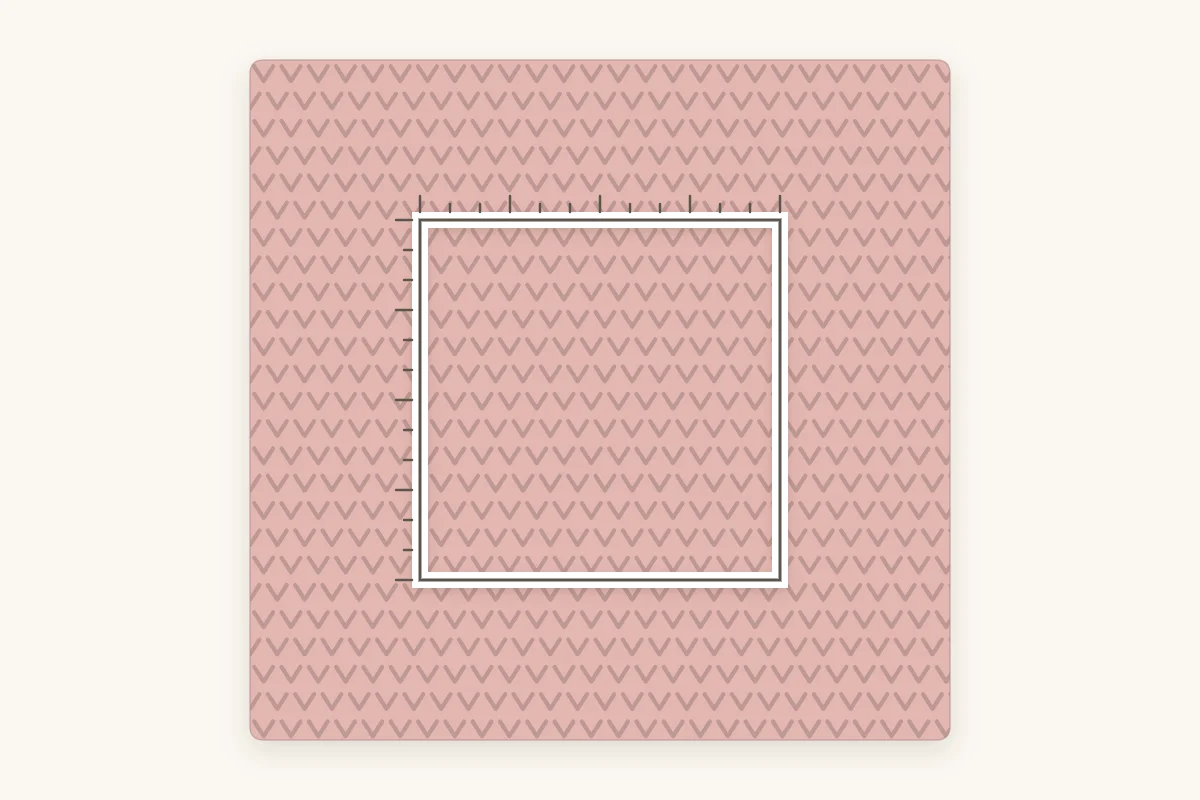
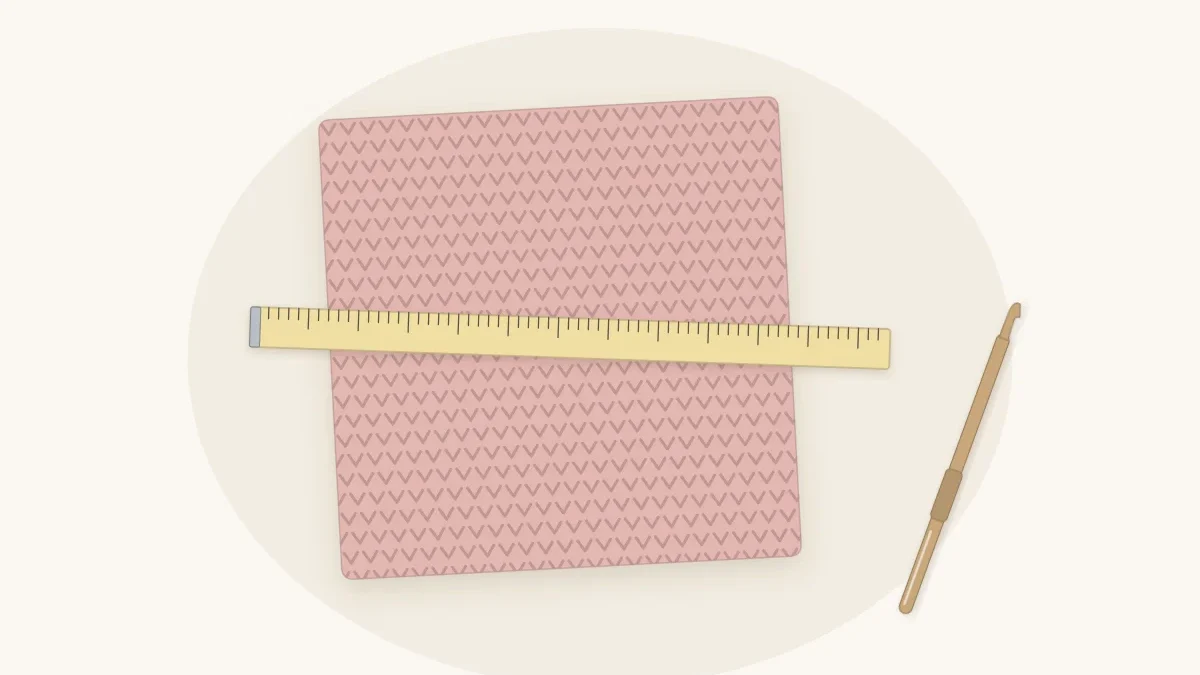
- Place a rigid ruler or a tape measure across the center of the swatch, parallel to a row.
- Mark the 0 and 4 in points with two pins or two removable stitch markers.
- Count the stitches between the marks, including any half stitch. Half stitches matter: over the full width of a blanket they add up to inches.
- Turn the ruler to run up the swatch and count the rows across 4 in the same way.
- Repeat in a second spot and compare. If the two counts differ, use the average.
Measure Again After Washing
Yarn changes when it gets wet. Cotton can tighten or relax, superwash wool often lengthens, and acrylic usually changes least. Because a baby blanket will be laundered many times, the washed measurement is the one that describes the finished blanket.
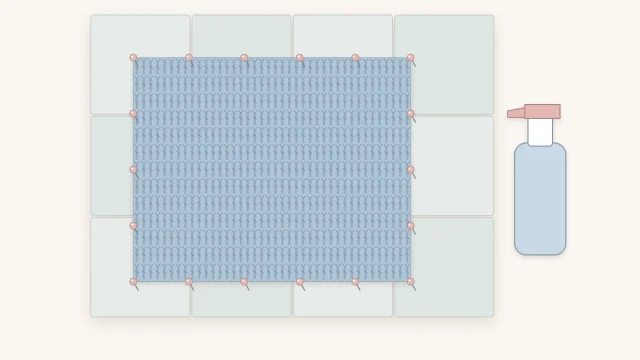
Write down the unwashed gauge first. Then wash and dry the swatch the way the yarn label instructs, lay it flat, and measure again. If the two sets of numbers differ, plan from the washed set.
What to Do When Your Gauge Is Off
Do not try to fix gauge by crocheting tighter or looser on purpose. Forced tension is tiring and drifts back to normal within a few rows. Change the hook instead.
- Too many stitches in 4 in: your stitches are too small. Go up one hook size, for example from US H-8 (5 mm) to US I-9 (5.5 mm).
- Too few stitches in 4 in: your stitches are too large. Go down one hook size, for example from US H-8 (5 mm) to US 7 (4.5 mm).
Make a new swatch with the new hook and measure again. If the stitch count matches but the row count does not, a blanket gives you an easy way out: work to the length in inches instead of to a fixed number of rows.
The Formula From Gauge to Chain Count
Two short calculations link gauge to the blanket.
Stitches needed = stitches per inch x target width in inches.
Starting chain = stitches needed + the extra chains for the turn.
With a gauge of 14 stitches over 4 in, you have 14 / 4 = 3.5 stitches per inch. For a 30 in (76 cm) blanket: 3.5 x 30 = 105 stitches. In double crochet, where the turning chain of 3 counts as the first stitch, add 2 to get 107 chains. In single or half double crochet with a turning chain of 1 that does not count as a stitch, add 1 to get 106 chains.
Length works the same way. At 2.5 rows per inch, a 35 in (89 cm) blanket needs 2.5 x 35 = 87.5, so about 88 rows. Stitch patterns with a repeat need one more adjustment, which is covered in how many chains to start a baby blanket. Gauge also feeds the yardage estimate in how much yarn you need.
Keeping Tension Consistent Over a Long Project
A swatch captures your tension on one day. A blanket takes many sittings, and tension shifts with mood, tiredness, posture and how you hold the yarn.
- Use the same hook throughout.
- Measure the width every 10 rows or so and compare it with the first measurement.
- Count the stitches when you measure. A changing width with a correct stitch count is a tension problem; a changing count is a missed or added stitch.
Watch out
If the width has drifted by more than about 1 in (2.5 cm), blocking will not fully hide it. Rip back to where the measurement was still correct, or change hook size by a half step for the remaining rows and keep checking.
Frequently asked questions
Do I really need a gauge swatch for a baby blanket?
If the exact size and yarn amount do not matter to you, you can skip it and accept whatever dimensions result. If you are aiming for a particular size, have a limited amount of yarn, or are using a different yarn than the pattern, the swatch is the only way to know the outcome in advance.
Can I unravel the swatch and reuse the yarn?
Yes. Many crocheters keep the swatch until the blanket is done, as a reference and a place to test washing, then pull it out if they run short. Yarn that has been washed or worked several times can look kinked, so use it for a border or wind it and let it relax first.
My stitch gauge matches but my row gauge does not. What now?
Prioritize stitch gauge, because it sets the width and cannot be changed once the first row is worked. Length is adjustable as you go: keep crocheting until the blanket reaches the stated measurement, even if that takes more or fewer rows than the pattern counts. Expect yarn use to shift slightly.