How Much Yarn Do You Need for a Baby Blanket?
Estimate the yarn for any crochet baby blanket from a swatch, with a fully worked example, a table of rough ranges by size and yarn weight, and notes on labels and dye lots.
Tutorial at a glance
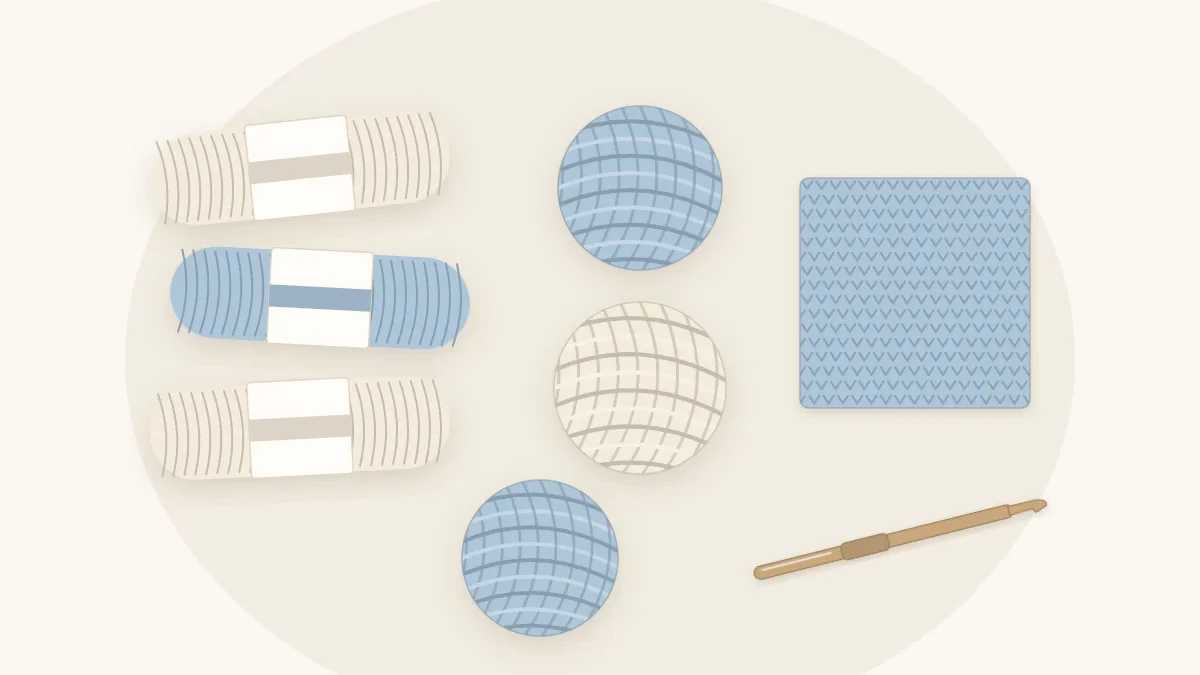
Materials
- One skein of the yarn planned for the blanket, with its label
- The hook planned for the blanket
- Kitchen scale that reads in grams
- Tape measure
- Paper and pencil or a calculator
A stroller-size blanket in worsted weight yarn often takes somewhere around 800 to 1,100 yards, but a range that wide can leave you one skein short. How much yarn you need for a baby blanket depends on the stitch, the hook, the thickness of the yarn and your own tension.
A small swatch turns the guess into a number you can shop with. The method takes one evening and a kitchen scale.
The Swatch Method
- Crochet a swatch in the blanket’s stitch with the yarn and hook you plan to use. Make it at least 6 x 6 in (15 x 15 cm).
- Measure its width and length and multiply them to get the area in square inches.
- Find out how much yarn the swatch used. Weigh it on a kitchen scale and convert grams to yards with the label, or unravel it and measure the yarn against a tape.
- Divide the yards by the area. The result is yards per square inch for that yarn, stitch and hook in your hands.
- Multiply by the area of the blanket, add the border, then add a margin of 10 to 15 percent.
The swatch you make for this is the same one you use to check gauge, so it does double duty. The guide to crochet gauge for blankets explains how to measure it flat.
A Fully Worked Example
Suppose the label says each skein weighs 100 g and holds 200 yd (183 m). That is 200 / 100 = 2 yards per gram.
The swatch. It measures 6 x 6 in, so its area is 36 square inches. It weighs 14 g, so it used 14 x 2 = 28 yards.
Yards per square inch. 28 / 36 = 0.78, rounded.
The blanket body. The plan is 30 x 35 in (76 x 89 cm), which is 1,050 square inches. 1,050 x 0.78 = 819 yards.
The border. A border 1 in (2.5 cm) deep makes the outside measurement 32 x 37 in, or 1,184 square inches. The border alone covers 1,184 – 1,050 = 134 square inches. 134 x 0.78 = about 105 yards.
The subtotal. 819 + 105 = 924 yards.
The margin. Adding 15 percent gives 924 x 1.15 = about 1,063 yards. Adding 10 percent gives about 1,016 yards.
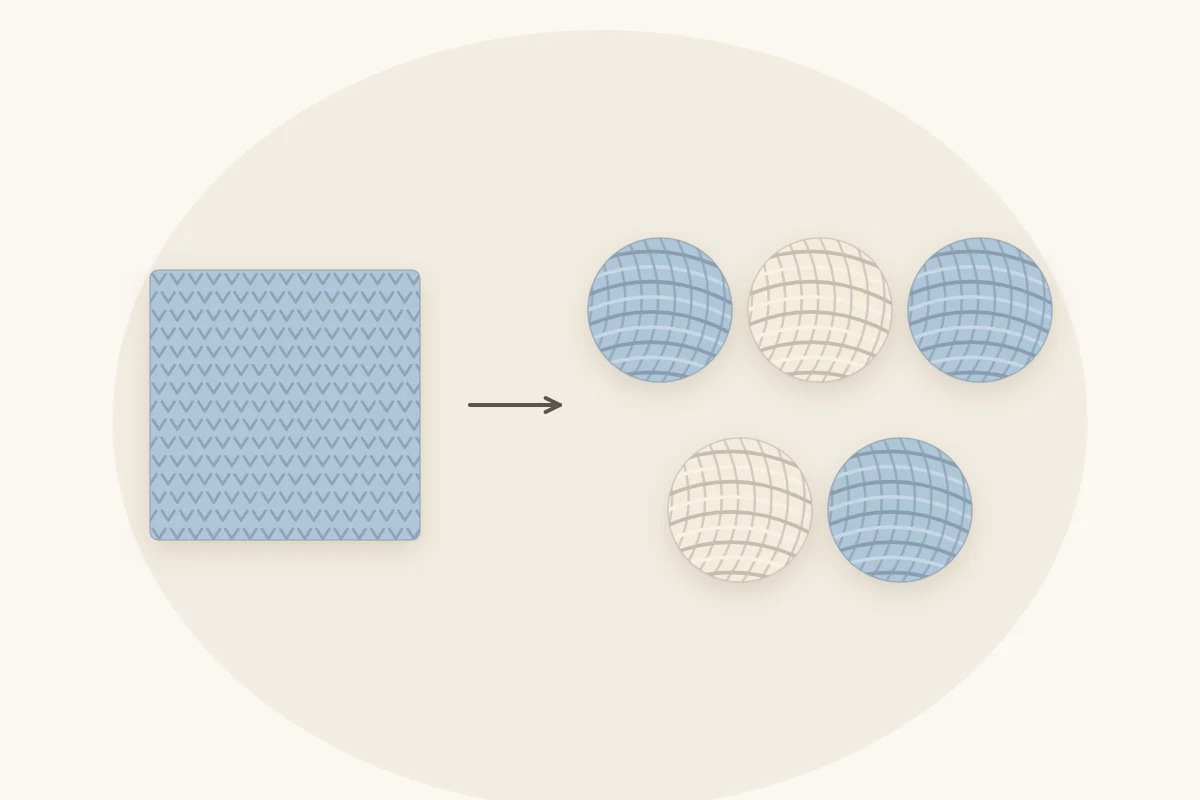
The skeins. 1,063 / 200 = 5.3, so you would buy 6 skeins.
The margin covers the things a swatch cannot predict: tension that loosens over weeks, tails left for weaving in, a few rows pulled out and redone, and a small weighing error that gets multiplied across the whole blanket.
Tip
A small swatch weighs very little, so a 1 g error matters. A larger swatch, about 8 x 8 in (20 x 20 cm), gives a steadier number on a scale that reads in whole grams.
What Changes Yarn Use
Four things move the number up or down.
- The stitch. Texture stitches fold or stack yarn into the fabric, so they use more yarn for the same area than plain rows. The waffle stitch is a clear case. Open stitches with chain spaces use less. The comparison of the best stitches for baby blankets ranks them against each other.
- The hook. A smaller hook packs more stitches into each inch and usually uses more yarn for the same area. A larger hook makes a looser fabric that goes further.
- The yarn weight. Thinner yarn needs more yards to cover an area, and thicker yarn needs fewer yards but more grams.
- Your tension. Tight crocheters make a denser fabric. This is why a yardage printed on a pattern only holds if you match its gauge.
Rough Estimates by Size and Yarn Weight
The table gives broad ranges for plain stitches such as single, half double or double crochet. These figures are estimates for planning only. Confirm them with a swatch before you buy, and expect texture stitches to land at or above the top of each range.
| Blanket size | DK weight (#3 light) | Worsted weight (#4 medium) | Bulky weight (#5 bulky) |
|---|---|---|---|
| Lovey, 12 x 12 in (30 x 30 cm) | about 140-180 yd | about 110-160 yd | about 75-110 yd |
| Stroller, 30 x 35 in (76 x 89 cm) | about 1,000-1,300 yd | about 800-1,100 yd | about 550-800 yd |
| Receiving, 36 x 36 in (91 x 91 cm) | about 1,200-1,600 yd | about 1,000-1,350 yd | about 700-1,000 yd |
| Crib-size, 36 x 52 in (91 x 132 cm) | about 1,750-2,300 yd | about 1,450-1,950 yd | about 1,000-1,400 yd |
The ranges do not include a border. Other sizes are listed in the baby blanket size chart, and the same swatch arithmetic works for all of them.
Reading the Label and Converting to Skeins
A yarn label states the weight of the skein in grams or ounces and its length in yards, meters or both. The length is the figure that matters. Two skeins of 100 g can hold very different lengths if one yarn is thicker than the other, so never compare yarns by grams alone.
If the label gives only meters, multiply by 1.094 to get yards. A 170 m skein holds 170 x 1.094 = about 186 yards.
To convert a total to skeins, divide the yards you need by the yards per skein and round up to the next whole skein. Needing 1,063 yards from 186 yd skeins means 1,063 / 186 = 5.7, so 6 skeins. Rounding down is how blankets end up three rows short.
The label also carries the fiber content, the care instructions and the suggested hook size. The guide to choosing yarn for a baby blanket walks through each part of it.
Dye Lots and the Extra Skein
Yarn is dyed in batches, and each batch gets a dye lot number printed on the label. Skeins from different lots can differ slightly in shade. The difference is hard to see in the skein and easy to see as a stripe across finished fabric.
Buy everything for one blanket at the same time and check that the lot numbers match. If your total lands close to a whole number of skeins, buy one more from the same lot. Finding the same lot later is often not possible.
Watch out
If you do have to mix lots, do not switch in the middle of the blanket. Use the odd skein for the border, where a slight change of shade reads as a design choice.
Keep one label with the project until the blanket is finished. It holds the lot number, the yardage and the care instructions in one place.
Frequently asked questions
How many skeins should I buy for a baby blanket?
It depends on the length of each skein, not its weight. Work out the total yards you need, divide by the yards printed on the label, and round up. For a worsted weight stroller-size blanket that often comes to between four and seven skeins, but the label and your swatch decide the real figure.
Can I rely on the yardage printed in a pattern?
It is a fair guide if you use a yarn of the same weight and match the pattern's gauge. If your stitches are tighter or looser, or you change the size, the amount changes too. Treat the pattern's figure as a starting estimate and add a margin before you buy.
What should I do with leftover yarn?
Keep a few yards with the label in a small bag. If a stitch ever comes loose or an end works its way out after washing, you will have yarn of the same color and lot for the repair. Larger leftovers can go into swatches for the next project.