How Many Chains to Start a Baby Blanket
Work out your own starting chain for any blanket width: measure a swatch, multiply by the width, fit the stitch multiple and add the turning chains, with checked examples and an estimate table.
Tutorial at a glance
Materials
- The yarn and hook chosen for the blanket
- A swatch at least 6 in (15 cm) wide in the blanket's stitch
- Tape measure
- Stitch markers for counting long chains
The number of chains to start a baby blanket comes from three things: how wide you want the blanket, how many stitches you make per inch, and what the stitch pattern needs at the edges. No single number works for everyone, because two people with the same yarn and hook rarely crochet at the same tension.
The Four-Step Method
- Make a swatch. Use the blanket’s yarn, hook and stitch, and make it at least 6 in (15 cm) wide.
- Measure stitches per inch. Lay the swatch flat, count the stitches across 4 in (10 cm) in the middle, and divide by 4.
- Multiply by the target width. The result is the number of stitches in each row.
- Adjust and add. Round to the stitch pattern’s multiple if it has one, then add the extra chains the first row uses up for turning.
Steps 1 and 2 are covered in detail in the guide to measuring crochet gauge. If you have not settled on a width yet, the baby blanket size chart lists the common ones.
Worked Example: Plain Double Crochet
Suppose the swatch has 14 double crochet stitches across 4 in. That is 14 / 4 = 3.5 stitches per inch. The target width is 30 in (76 cm).
3.5 x 30 = 105 stitches in each row.
In double crochet, the first stitch of Row 1 usually goes into the fourth chain from the hook, and the three skipped chains count as the first stitch. That takes 2 chains more than the stitch count, so the starting chain is 105 + 2 = 107 chains.
You can check it: the 3 skipped chains stand as 1 stitch, and the other 104 chains each hold 1 stitch. 1 + 104 = 105.
The extras for the three basic stitches, as they are most often written:
- Single crochet: stitches + 1. The first stitch goes in the second chain from the hook, so 105 stitches need 106 chains.
- Half double crochet: stitches + 1 when the first stitch goes in the second chain from the hook and the turning chain does not count as a stitch.
- Double crochet: stitches + 2 when the turning chain of 3 counts as a stitch, as in this simple double crochet blanket.
When a pattern states its own turning-chain rule, follow it.
Worked Example: A Pattern With a Multiple
A multiple is the number of stitches in one repeat of a stitch pattern. “Chain a multiple of 2 + 1” means the chain count must be some number of pairs plus 1, so it is always odd. When the multiple is stated for the chain, the turning extras are already included.
Suppose the swatch has 16 stitches across 4 in, or 4 per inch, and the target width is 36 in (91 cm). 4 x 36 = 144. That number is even, so it does not fit. The nearest numbers that do are 143 (2 x 71 + 1) and 145 (2 x 72 + 1). Either one changes the width by a quarter of an inch (0.6 cm), which no one will see.
Larger multiples move the width more. A shell stitch blanket that begins with a chain of a multiple of 6 + 2 and aims for about 105 stitches offers these choices:
- 6 x 17 + 2 = 104 chains, which gives 103 stitches, or about 29.4 in (75 cm) at 3.5 stitches per inch.
- 6 x 18 + 2 = 110 chains, which gives 109 stitches, or about 31.1 in (79 cm).
Read the pattern carefully to see whether its multiple describes the chain or the stitches, because the two differ by the turning extras.
Quick Estimate Table
These counts are estimates worked out from the gauge in the first column. They are a starting point for planning, and your own swatch should confirm them before you chain.
| Gauge over 4 in (10 cm) | Blanket width | Stitches per row | Chains for single crochet | Chains for double crochet |
|---|---|---|---|---|
| 12 stitches | 30 in (76 cm) | 90 | 91 | 92 |
| 12 stitches | 36 in (91 cm) | 108 | 109 | 110 |
| 14 stitches | 30 in (76 cm) | 105 | 106 | 107 |
| 14 stitches | 36 in (91 cm) | 126 | 127 | 128 |
| 16 stitches | 30 in (76 cm) | 120 | 121 | 122 |
| 16 stitches | 36 in (91 cm) | 144 | 145 | 146 |
Why the Chain Is Often Tighter Than the Fabric
A chain has no height and very little stretch, and many crocheters pull each chain snug without noticing. The rows above it relax to their natural width, so the bottom edge ends up shorter than the rest and the blanket fans out from the first row. Two fixes work well:
- Use a larger hook for the chain only. Go up one or two sizes, for example US I-9 (5.5 mm) for the chain and US H-8 (5 mm) for the rows.
- Replace the chain with foundation single crochet. This makes the chain and the first row of single crochet together, and the edge stretches like the rest of the fabric.
Foundation Single Crochet in Words
- Chain 2. Insert the hook into the second chain from the hook, yarn over and pull up a loop. There are 2 loops on the hook.
- Yarn over and pull through 1 loop only. This forms the chain at the base of the stitch.
- Yarn over and pull through both loops. The first stitch is done.
- For each further stitch, insert the hook under both strands of the chain made in step 2 of the previous stitch, then repeat steps 1 to 3 from “yarn over and pull up a loop.”
Each foundation single crochet is one chain and one stitch, so make exactly as many as the stitch count, with no extras: 105 for the example above.
Measuring the Chain Before You Commit
Lay the finished chain flat on a table next to a tape measure. Do not stretch it and do not let it twist. It should come close to the planned width.
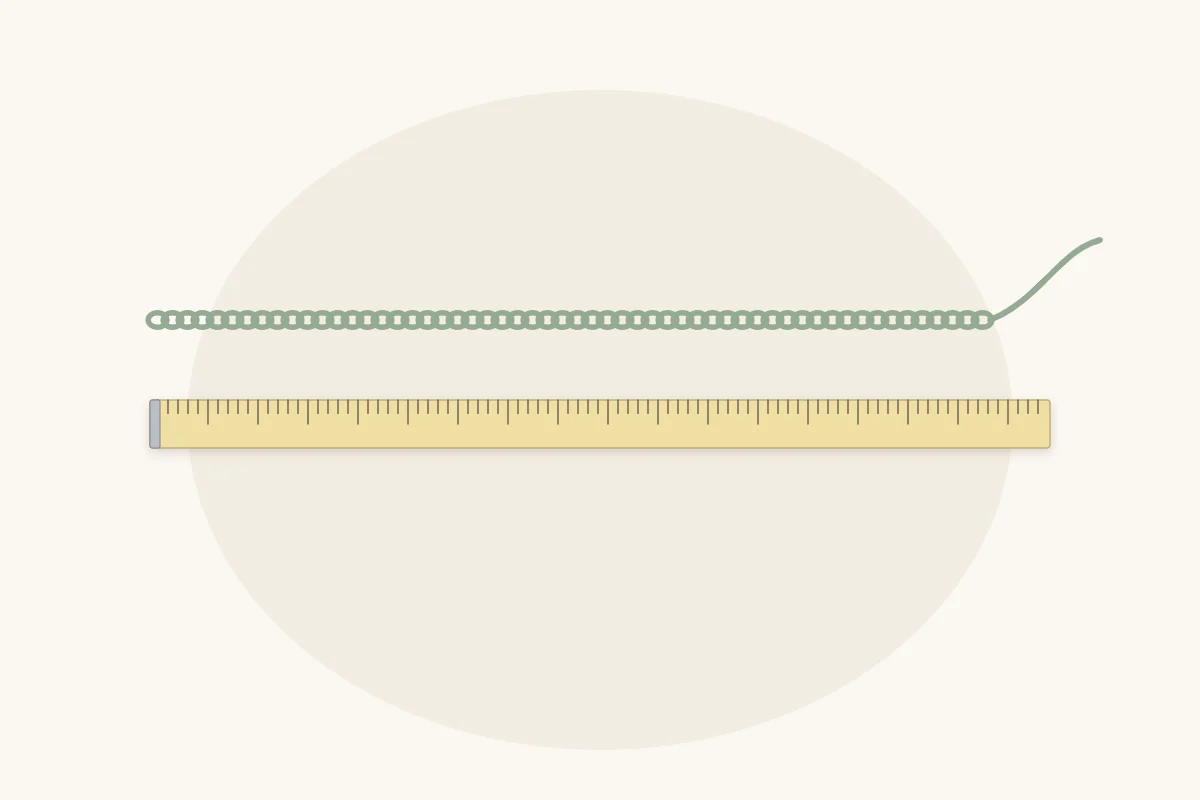
The stitch count decides the final width, not the chain’s length, so a small difference is fine. If the chain is more than about 1 in (2.5 cm) shorter than the target, it is probably too tight, and it is quicker to redo it now than to live with a pinched edge.
When you count, leave out the slip knot and the loop on the hook. A long chain is easy to miscount, which is one of the common beginner blanket mistakes.
Tip
Clip a stitch marker into every 20th chain as you go, and count the stitches again at the end of Row 1.
Frequently asked questions
Can I use the chain count from someone else's blanket?
Only as a rough guide. A chain count depends on the yarn, the hook and the tension of the person who made it. With the same number of chains your blanket may come out a few inches wider or narrower. A short swatch and one multiplication give a count that fits your own stitches.
What happens if I chain too many?
Nothing serious. If you finish Row 1 with unused chains left over, you can undo them from the slip-knot end by loosening the knot and easing the tail back through each loop. Chaining too few is the harder problem, because the only fix is to pull out the row and add chains.
Does the slip knot count as a chain?
No. The slip knot only anchors the yarn to the hook. Start counting with the first chain you pull through it, and do not count the loop sitting on the hook either. Each chain looks like a small V on the front, and counting those Vs gives the correct total.