Shell Stitch for Baby Blankets: Tutorial and Simple Pattern
Learn the basic five-double-crochet shell and work it into a 30 x 35 in baby blanket, with a checked two-row repeat, half shells at the edges and the chain math written out.
Tutorial at a glance
Materials
- Worsted weight (#4 medium) yarn, about 1,100-1,300 yd
- US H-8 (5 mm) crochet hook
- Blunt yarn needle
- Scissors and tape measure
- Two locking stitch markers (optional)
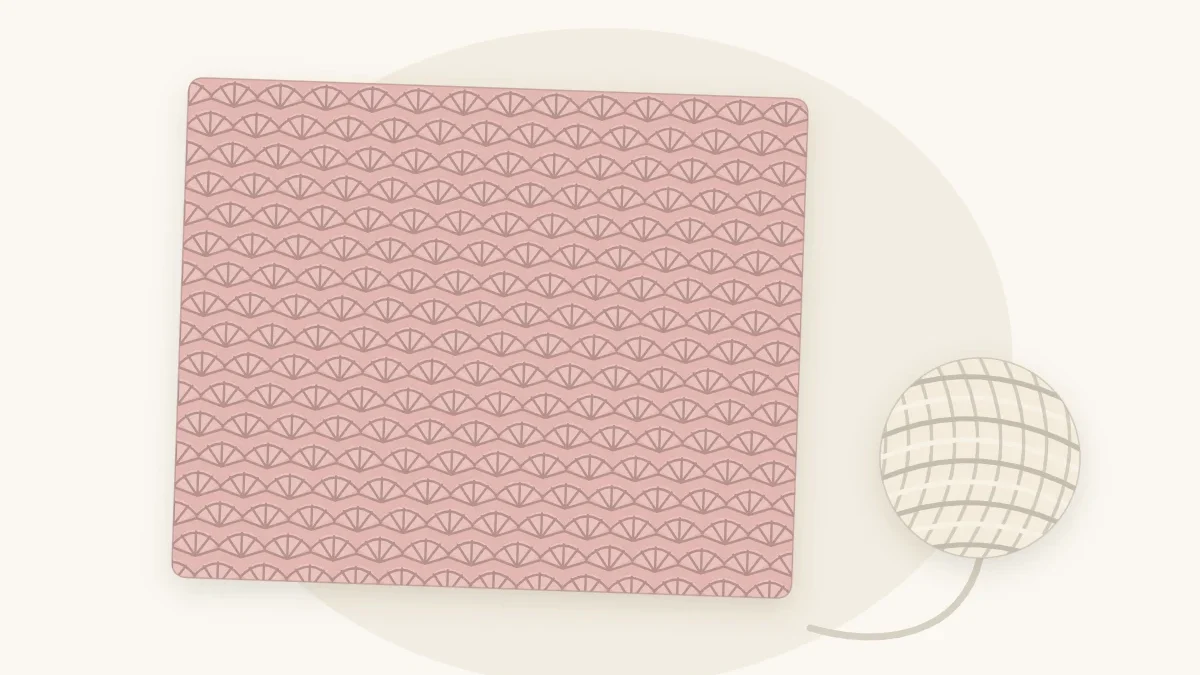
A shell is a group of double crochet stitches worked into one stitch so that they fan out. Stacked in offset rows, shells make a scalloped texture that looks more involved than it is: the whole fabric is a two-row repeat built from single crochet and double crochet. This shell stitch baby blanket uses the basic five-stitch shell, with half shells at the edges so the sides stay straight.
The fabric has small gaps where stitches are skipped, and it uses more yarn than plain rows of the same size because five stitches share one base. If you can work a plain double crochet blanket with even edges, you have the skills for this one.
How the Shell Stitch Works
Each shell is 5 dc worked into the same stitch. Two stitches are skipped before it and two after it, which gives the fan room to spread, and a single crochet on each side pins it down. One shell plus one single crochet uses 6 stitches of the row below, so the pattern needs a multiple of 6 stitches, plus 1 for the single crochet that balances the far end.
On the next row everything shifts by half a repeat. A single crochet goes into the center (third) double crochet of each shell, and a new shell goes into each single crochet. Because of that shift, the row begins and ends with a half shell of 3 dc instead of a full one.
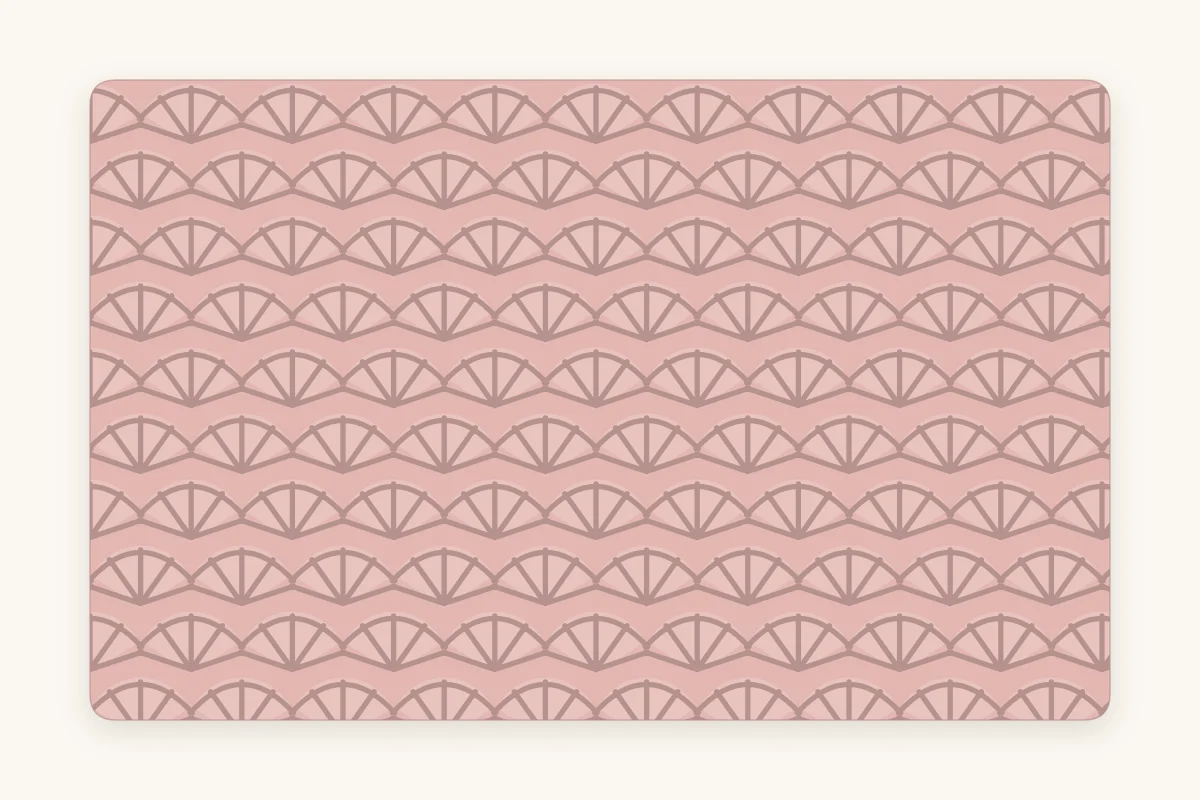
To practice, chain 14. That gives 13 stitches: two full shells and three single crochets in Row 1, then one full shell between two half shells in Row 2.
Materials
- Worsted weight (#4 medium) yarn, about 1,100-1,300 yd (1,005-1,190 m)
- US H-8 (5 mm) crochet hook
- Blunt yarn needle
- Scissors and a tape measure
- Two locking stitch markers (optional, for the edge stitches)
The yardage is an estimate and depends on your gauge. Buy a little extra from the same dye lot, and see how to estimate yarn for a blanket if you change the size.
Finished Size and Gauge
About 30 x 35 in (76 x 89 cm) before any border.
Gauge target: 3 pattern repeats (18 stitches) = 5 in (12.5 cm) wide, and 8 rows = 4 in (10 cm) tall, measured over the shell pattern. Matching it matters for the finished size and for the amount of yarn. For a swatch, chain 26 and work 12 rows; the guide to measuring gauge explains how to check it.
The starting chain follows from the gauge. A width of 30 in divided by 5 in is 6, and 6 x 3 repeats = 18 repeats. Then 18 x 6 = 108 stitches, plus 1 = 109 stitches, plus 1 turning chain = 110 chains. For another width, chain any multiple of 6, plus 2.
Abbreviations
- ch = chain
- sc = single crochet
- dc = double crochet
- sk = skip
- st(s) = stitch(es)
Pattern Notes
- This pattern uses US crochet terms.
- The ch 3 at the start of Row 2 counts as the first dc. The ch 1 at the start of Row 3 does not count as a stitch.
- Shell: 5 dc in the same stitch. Half shell: 3 dc in the same stitch. At the start of Row 2 the ch 3 plus 2 dc make the half shell.
- Every row has 109 stitches.
Instructions
Ch 110.
Row 1: Sc in 2nd ch from hook, *sk 2 ch, 5 dc in next ch, sk 2 ch, sc in next ch; repeat from * across. (18 shells and 19 sc)
Row 2: Ch 3, turn, 2 dc in first sc, *sk 2 dc, sc in next dc (the center of the shell), sk 2 dc, 5 dc in next sc; repeat from * across, working only 3 dc in the last sc. (17 shells, 2 half shells and 18 sc)
Row 3: Ch 1, turn, sc in first dc, *sk 2 dc, 5 dc in next sc, sk 2 dc, sc in next dc (the center of the shell); repeat from * across, working the last sc in the top of the ch 3. (18 shells and 19 sc)
Repeat Rows 2 and 3 until the blanket measures about 35 in (89 cm), ending after a Row 3. At the target gauge that is about 71 rows, but go by the tape measure.
Checking Your Count
Counting 109 stitches on every row is slow. Count shells instead: every Row 3 has 18 full shells, and every Row 2 has 17 full shells with a half shell at each end. If a row comes up short, look at the edges first.
Watch out
The two usual errors are both at the row ends. Leaving out the 2 dc after the ch 3 in Row 2 makes the side slope inward, and so does missing the last sc of Row 3, which belongs in the top of the turning chain. A marker in the top of each ch 3 makes that stitch easy to find.
Tip
If the bottom edge curves or feels tighter than the rows above it, the foundation chain is too tight. Rework it with a hook one size larger, then switch back to the US H-8 (5 mm) hook for Row 1.
Finishing
Fasten off, leaving a 6 in (15 cm) tail. Weave in the ends through the solid parts of the fabric, following the posts of the double crochets instead of crossing a gap, where a tail would show.
Shells benefit from blocking, which opens the fans and evens out the rows. Choose a method that suits the fiber and the care label; the steps are in how to block a crochet blanket.
The side edges alternate between a single crochet and a tall half shell, so they look slightly uneven until an edging is added. One or two rounds of single crochet tidy them and keep the edge flat and close to the fabric.
Frequently asked questions
What is the stitch multiple for the shell stitch?
This version needs a multiple of 6 stitches plus 1. Because the first single crochet goes into the second chain from the hook, the starting chain is a multiple of 6 plus 2. For example, 24 + 2 = 26 chains gives a swatch of four repeats, and 108 + 2 = 110 chains gives the blanket.
Why are the sides of my shell stitch blanket slanting inward?
A stitch is being lost at one end of the row. On the rows that begin with a chain 3, two more double crochets belong in the very first single crochet. On the rows that begin with a chain 1, the final single crochet goes into the top of the chain 3 from the row below.
Can the shell stitch be worked in DK yarn instead of worsted?
Yes. Use a light (#3) DK yarn with a hook near the size printed on its label, often US G-6 (4 mm). The shells will be smaller, so swatch, measure how wide three repeats are, and chain more repeats to reach the same width. Keep the chain a multiple of 6 plus 2.