Best Crochet Stitches for Baby Blankets (and How to Choose)
Nine common crochet stitches compared on difficulty, gaps, drape, thickness, yarn use and speed, with a table and plain rules for matching a stitch to the blanket you want.
Tutorial at a glance
Materials
- Yarn in the weight you plan to use for the blanket
- Crochet hook in the size range printed on the yarn label
- Tape measure
- Scissors
The best crochet stitches for baby blankets are the ones that give you the fabric you want at a pace you can keep up. Nine stitches cover almost every blanket a beginner is likely to make, and each one trades density, thickness, yarn and speed in a different way.
This comparison uses US crochet terms and describes each stitch by the fabric it produces. The differences are relative: your yarn, hook and tension shift every one of them, so a small swatch is still the final test.
Six Things to Compare
- Difficulty: how many different movements a row has and how easy it is to see where the next stitch goes.
- Density: the size of the gaps between stitches. This is a property of the fabric and nothing more.
- Drape: whether the fabric hangs loosely or holds its shape.
- Thickness: how deep the fabric is from front to back.
- Yarn use: how much yarn covers the same area, compared with the other stitches here.
- Speed: how quickly the rows add length.
Stitch Comparison Table
| Stitch | Difficulty | Gaps | Thickness | Yarn Use | Speed |
|---|---|---|---|---|---|
| Single crochet | Easy | Very small | Medium, firm | Medium to high | Slow |
| Half double crochet | Easy | Small | Medium | Medium | Medium |
| Double crochet | Easy | Narrow slits between posts | Thinner | Lower | Fast |
| Moss (linen) | Easy | Very small, offset | Thin to medium | Medium | Slow to medium |
| Lemon peel | Easy | Small | Medium, pebbly | Medium to high | Medium |
| Waffle | Intermediate | Small | Very thick | High | Slow to medium |
| Shell | Advanced beginner | Small openings around each shell | Medium | Medium to high | Medium |
| V-stitch | Easy | Open | Thin | Low | Fast |
| Granny clusters | Easy | Open between clusters | Medium | Lower | Fast |
The Three Basic Stitches
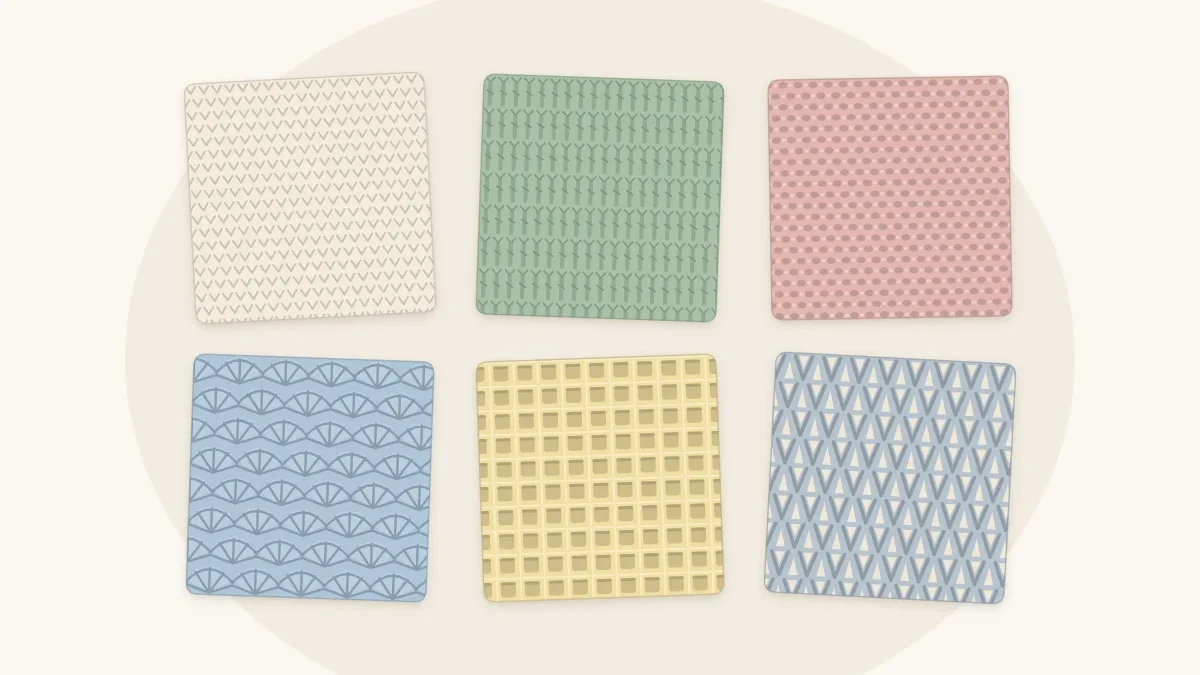
Single crochet (sc) is the shortest stitch. Its rows are low and tightly packed, so the fabric is dense and fairly firm, with almost no gaps. The cost is time: a blanket needs many more rows of single crochet than of any taller stitch, and all those rows add up in yarn as well.
Half double crochet (hdc) adds one yarn over and makes a stitch about halfway between single and double crochet in height. The fabric stays dense but bends more easily, and the rows build noticeably faster. A half double crochet blanket is a common first project for that reason.
Double crochet (dc) is roughly twice the height of single crochet. Each stitch is a tall post, and narrow slits show between the posts when the fabric is stretched. It makes the thinnest and most flexible fabric of the three, uses the least yarn for its area, and grows the fastest.
Dense Stitches With Texture
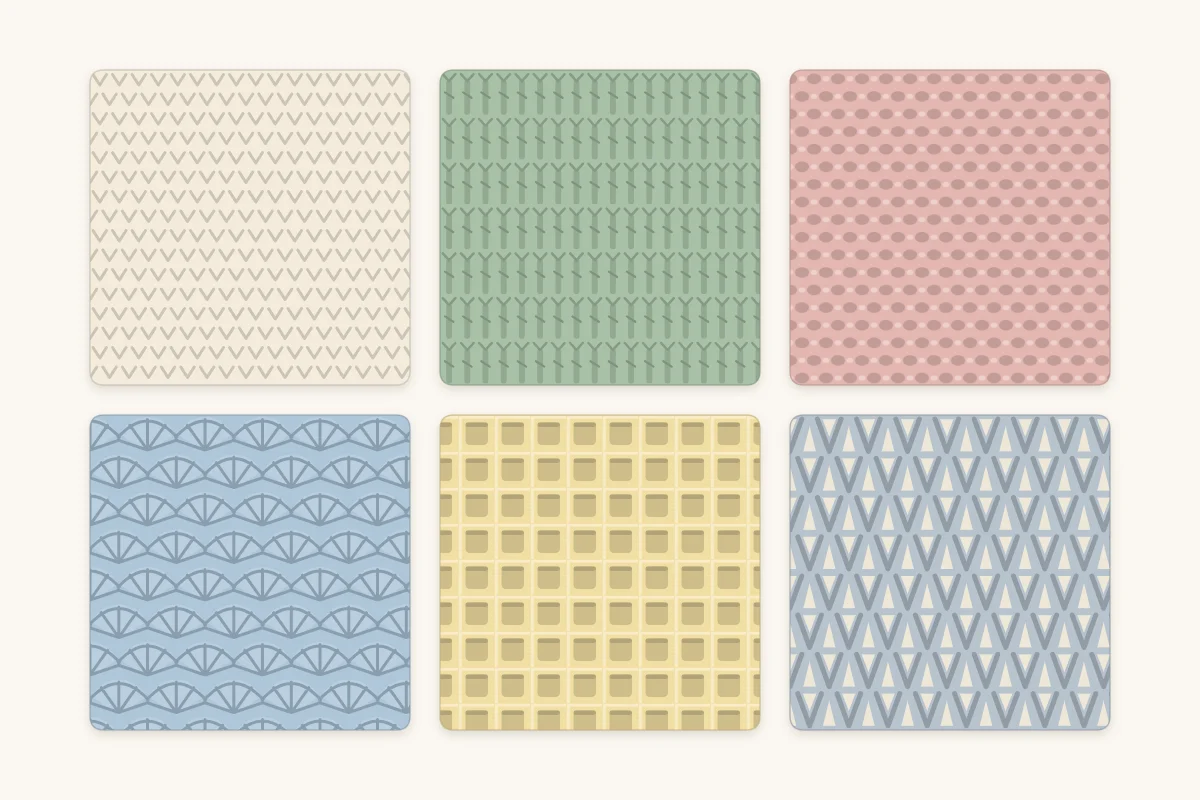
Moss stitch, also called linen or granite stitch, alternates one single crochet with one chain, and each single crochet sits in the chain space of the row below. The small offset stitches look woven. The fabric is close but thinner and more flexible than plain single crochet, because the chains take the place of half the stitches. See the moss stitch pattern for the row repeat.
Lemon peel stitch alternates single and double crochet across a row, then swaps them on the next row. The tall stitches are squeezed between short ones and pop out slightly, which makes a pebbly surface that is the same on both sides. It is covered in the lemon peel pattern.
Waffle stitch uses front post double crochet, a stitch worked around the post of the stitch below instead of into its top. The raised posts form a grid of small recessed squares. The fabric is the thickest in this list, and it pulls in narrower than plain double crochet over the same number of stitches. It also uses clearly more yarn. The waffle stitch tutorial explains the post stitch step by step.
Open and Decorative Stitches
A shell is a group of several double crochets worked into one stitch so that they fan out. Rows of shells give a scalloped surface with small openings where the fans meet. Packing five stitches into one place takes more yarn than a plain row does. The shell stitch tutorial starts with a single shell before the blanket.
V-stitch is two double crochets with one chain between them, worked into the same place, with skipped stitches on either side. Every row is a line of small openings, so the fabric is thin, loose and quick to make, and it uses the least yarn here.
Granny clusters are groups of three double crochets separated by gaps. They are the building block of granny squares and also work in straight rows. The clusters themselves are solid and the spaces between them are open, so the fabric is flexible and grows quickly.
How to Choose a Stitch
Start with the fabric, then check it against your patience and your yarn budget.
- For warmth and structure, choose a dense stitch: single crochet, half double crochet, moss, lemon peel or waffle. Smaller gaps and more yarn in each square inch make a fabric that holds its shape.
- For a light blanket, choose an open stitch: V-stitch, granny clusters or plain double crochet. Less yarn in each square inch makes a thinner fabric that folds small.
- For texture, plan for more yarn. Waffle, lemon peel and shell all use more than plain rows over the same area, so buy extra from the same dye lot.
- For a first blanket, pick a one-stitch fabric. Half double crochet and double crochet let you concentrate on counting and straight edges.
- For speed, pick a tall stitch. Double crochet, V-stitch and granny clusters add the most length per row.
Tip
Yarn weight changes the result as much as the stitch does. A dense stitch in thin yarn can make a lighter fabric than an open stitch in bulky yarn. Decide on the yarn and the stitch together, then swatch that exact pair.
Swatch Before You Commit
A table can only rank stitches against each other. To see what a stitch does in your yarn, chain enough for about 6 in (15 cm), work the stitch for 6 in, and handle the square. Fold it, stretch it gently, and hold it up to see how it hangs.
Check two things. First, the feel: stiff fabric usually wants a larger hook, and loose, shapeless fabric a smaller one. Second, the gaps: lay the swatch flat and see how much of the surface under it shows through.
Keep the swatch. Measured flat, it gives you the gauge for working out the starting chain.
Frequently asked questions
Which crochet stitch is easiest for a first baby blanket?
Half double crochet and double crochet are the usual starting points. Each row repeats one movement, the stitches are tall enough to see clearly, and the rows add length quickly enough to stay motivating. Single crochet is just as simple to make but takes many more rows to reach the same length.
Which stitches use the most yarn?
Stitches that stack or crowd yarn use the most: waffle stitch first, then shells and lemon peel. Single crochet also uses a fair amount because its rows are so short. Open stitches such as V-stitch and granny clusters use the least. Treat this as a ranking only and confirm the amount with a swatch.
Can I combine two stitches in one blanket?
Yes, but swatch both first. Different stitches rarely share the same width over the same stitch count, so a band of waffle stitch will pull in beside plain double crochet. Combinations work best when the stitches have a similar gauge, or when you adjust the stitch count between sections.