Textured Baby Blanket Pattern (Lemon Peel Stitch)
A full lemon peel stitch pattern that alternates single and double crochet for a pebbly, reversible fabric, with gauge, chain arithmetic and a stitch-by-stitch check of the row logic.
Tutorial at a glance
Materials
- Worsted weight (#4 medium) yarn, about 950-1,150 yd
- US H-8 (5 mm) crochet hook
- Blunt yarn needle
- Scissors
- Tape measure
- One stitch marker (optional)
Lemon peel stitch makes a textured baby blanket out of the two most familiar stitches in crochet. Single crochet and double crochet alternate across the row, and on the next row they trade places. The short and tall stitches push against each other and the surface turns pebbly, a little like citrus peel.
There is one row to learn, and it repeats from the second row to the last. The pattern is written in US crochet terms.
Materials
- Worsted weight (#4 medium) yarn, about 950-1,150 yd (870-1,050 m)
- US H-8 (5 mm) crochet hook
- Blunt yarn needle
- Scissors and a tape measure
- One stitch marker (optional)
The yarn amount is an estimate. It depends on your gauge and on the border you add, so buy a little extra from the same dye lot.
Finished Size
About 30 x 34 in (76 x 86 cm) before the border.
Gauge
14 stitches and 12 rows = 4 in (10 cm) in lemon peel stitch, measured flat. Matching this target matters for the finished size and for how much yarn the blanket uses.
For a swatch, chain 23 and work 18 rows. That gives 22 stitches, a piece a little over 6 in (15 cm) wide and about 6 in tall. Measure across the middle. The article on measuring crochet gauge covers the method.
The starting chain follows from the gauge. Fourteen stitches in 4 in is 3.5 stitches per inch, and 3.5 x 30 in = 105 stitches. The pattern needs an even number, so round up to 106, which adds about 1/4 in (0.6 cm). Add 1 chain for the turn: 107 chains. Twelve rows in 4 in is 3 rows per inch, and 3 x 34 in = 102 rows.
Abbreviations
- ch – chain
- sc – single crochet
- dc – double crochet
- st(s) – stitch(es)
Pattern Notes
- The stitch count is an even number. The starting chain is that even number plus 1, so the chain itself is odd. To change the width, add or remove chains in pairs.
- The turning ch-1 does not count as a stitch. Do not work into it at the end of a row.
- Because the count is even, every row begins with a single crochet and ends with a double crochet.
- The rule for the whole blanket: single crochet goes into double crochet, and double crochet goes into single crochet.
- Every row has 106 stitches: 53 sc and 53 dc.
Instructions
Chain 107 loosely. If your chains tend to be tighter than your stitches, make the chain with a hook one size larger and then change back.
Row 1: Sc in the 2nd ch from the hook, dc in the next ch. *Sc in next ch, dc in next ch; repeat from * across. The last dc lands in the last chain. (106 sts)
Row 2: Ch 1, turn. Sc in the first st (a dc), dc in the next st (a sc). *Sc in next dc, dc in next sc; repeat from * across. The last dc goes into the first sc of the row below. (106 sts)
Rows 3-102: Repeat Row 2, or continue until the piece measures about 34 in (86 cm) from the starting chain.
Fasten off, leaving a 6 in (15 cm) tail.
Check the Count on a Small Sample
Chain 7 to see how the rows fit together. In Row 1, skip the first chain, then work sc, dc, sc, dc, sc, dc into chains 2 through 7. That is 6 stitches, and the row ends on a double crochet.
Chain 1 and turn. Reading from the hook, the stitches of Row 1 now run dc, sc, dc, sc, dc, sc. Row 2 puts a single crochet in the first one and a double crochet in the second, and keeps alternating: sc into dc, dc into sc, three times over. That is 6 stitches again, and the last double crochet sits in the single crochet that began Row 1.
Row 2 also ends on a double crochet, so Row 3 meets the same order and is worked the same way. The count stays at 6, as the blanket stays at 106.
Watch out
If you are about to work a single crochet into a single crochet, a stitch was skipped or added earlier in the row. Look back for two matching stitches side by side and pull out to that point.
Finding the First and Last Stitch
Most lost stitches happen at the edges. The first single crochet of a row goes into the very first stitch, the double crochet directly below the turning chain.
The last stitch of the row below is a single crochet. It is short and sits low beside the old turning chain, so it can hide. Work the final double crochet into it and leave the turning chain alone. A stitch marker in the first single crochet of each row marks the spot for the return trip. For practice with the short stitch on its own, see the single crochet blanket pattern.
Why the Texture Uses More Yarn
A double crochet is about twice as tall as a single crochet. In this stitch the two sit side by side in one row, so the row can only be as tall as the pair allows. The double crochets cannot stand at full height. They are held down by their short neighbors and bow outward instead, and those small bulges are the pebbles.
That extra length of yarn adds thickness, not height. Each row is shorter than a row of plain double crochet but holds just as much yarn in every tall stitch, so the blanket takes somewhat more yarn for its size than flat rows of either stitch alone.
The texture is reversible. Rows are worked from alternate sides, so the bumps appear on both faces and neither side is the back. For how this stitch compares with others, see the guide to the best stitches for baby blankets.
Finishing
Thread each tail onto the yarn needle and run it through the bases of the stitches in at least three directions before trimming. The steps are in the guide to weaving in ends.
A flat border evens out the side edges. Work one round of single crochet: one stitch in each stitch along the top and bottom, about 3 stitches for every 2 row ends along the sides, and 3 in each corner. The article on a simple single crochet border has the full method.
Wash and dry the blanket as the yarn label directs, then check both sides for any tail that has worked loose and weave it back in.
Frequently asked questions
What happens if I start with an odd number of stitches?
The stitch still works, but the rows stop being identical. A row that begins and ends with single crochet is followed by one that begins and ends with double crochet, so you need two different rows and a different turning chain for each. An even count keeps one row for the whole blanket.
Why use chain 1 to turn when the row ends with a tall stitch?
The turning chain matches the stitch that starts the next row, and every row here starts with a single crochet. One chain lifts the yarn to that height. The double crochet at the other end of the row needs no chain because it is the last stitch worked, not the first.
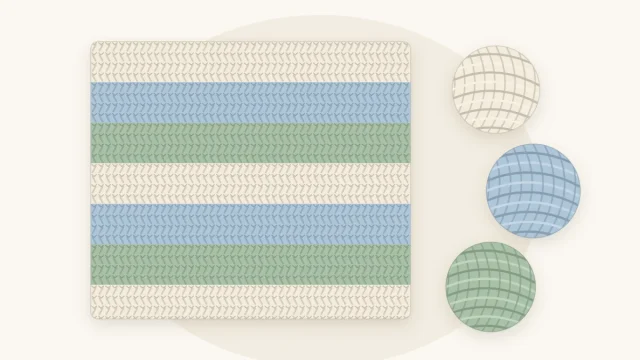
Is lemon peel stitch a good choice for stripes?
Yes. Because single and double crochet alternate, the line between two colors is slightly uneven instead of ruled straight, which softens narrow stripes. Use stripes with an even number of rows so the color changes stay on one edge, and change color in the last yarn over of the final double crochet.