Moss Stitch Baby Blanket Pattern
A full moss stitch pattern in worsted yarn: gauge target, chain arithmetic, a one-row repeat with the count checked on a small sample, and notes on how stripes look in this stitch.
Tutorial at a glance
Materials
- Worsted weight (#4 medium) yarn, about 850-1,050 yd
- US I-9 (5.5 mm) crochet hook
- Blunt yarn needle
- Scissors
- Tape measure
- One stitch marker (optional)
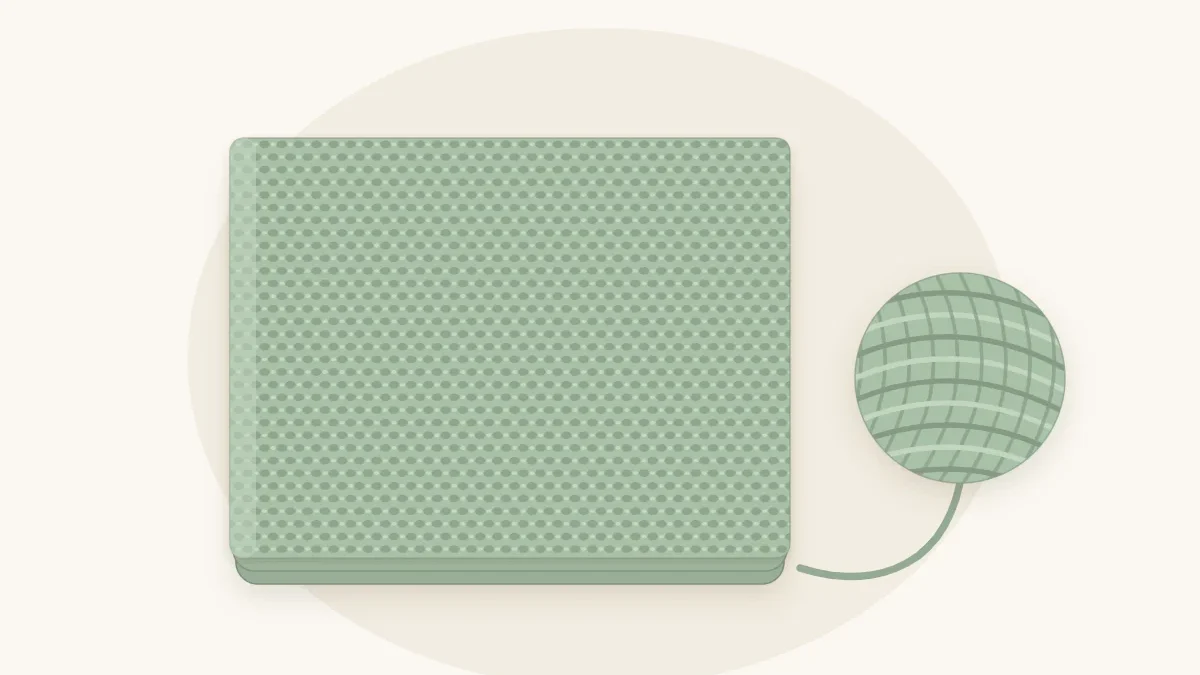
Moss stitch uses only two things you already know, the single crochet and the chain, and arranges them so the fabric looks woven. A moss stitch baby blanket is flat, close-textured and the same on both sides, and after the first row every row is identical.
The stitch is also called linen stitch or granite stitch. All three names describe the same repeat: one single crochet, one chain, skip one stitch. This pattern is written in US crochet terms.
Materials
- Worsted weight (#4 medium) yarn, about 850-1,050 yd (780-960 m)
- US I-9 (5.5 mm) crochet hook
- Blunt yarn needle
- Scissors and a tape measure
- One stitch marker (optional)
The yarn amount is an estimate. It depends on your gauge and on the border you add, so buy a little extra from the same dye lot.
Finished Size
About 30 x 34 in (76 x 86 cm) before the border.
Gauge
16 stitches and 16 rows = 4 in (10 cm) in moss stitch, measured flat. Count each single crochet and each chain-1 space as one stitch, so 16 stitches means 8 single crochets and 8 spaces. Matching this target matters for the finished size and for how much yarn the blanket uses.
For a swatch, chain 26 and work 24 rows. That gives a piece 24 stitches wide, about 6 in (15 cm) square. Measure in the middle. More than 16 stitches in 4 in calls for a larger hook; fewer, a smaller one. The guide to measuring crochet gauge explains the method.
The starting chain follows from the gauge. Sixteen stitches in 4 in is 4 stitches per inch, and 4 x 30 in = 120 stitches. Add 2 chains for the turn: 122 chains.
Abbreviations
- ch – chain
- sc – single crochet
- sk – skip
- sp – space
- st(s) – stitch(es)
Pattern Notes
- Chain any even number. To change the width, add or remove chains in pairs. Each pair adds or removes one single crochet and one space, about 1/2 in (1.3 cm) at the stated gauge.
- The turning ch-2 is not a single crochet. It stands in for the edge of the row and one ch-1 space. The last single crochet of every row goes into the space under that chain.
- From Row 2 on, every single crochet is worked into a ch-1 space, never into the top of a stitch. Insert the hook under the chain, into the gap.
- Every row has 60 single crochets and 59 ch-1 spaces, plus the turning chain.
Instructions
Chain 122 loosely. If your chains tend to be tighter than your stitches, make the chain with a hook one size larger and then change back.
Row 1: Sc in the 4th ch from the hook (the 3 skipped chains count as the turning chain and the first space). *Ch 1, sk 1 ch, sc in next ch; repeat from * across. The last sc lands in the last chain. (60 sc, 59 ch-1 sps)
Row 2: Ch 2, turn. Sc in the first ch-1 sp. *Ch 1, sc in next ch-1 sp; repeat from * across. After the sc in the last ch-1 sp, ch 1 and sc in the space under the turning chain. (60 sc, 59 ch-1 sps)
Rows 3-136: Repeat Row 2, or continue until the piece measures about 34 in (86 cm) from the starting chain.
Fasten off, leaving a 6 in (15 cm) tail.
Check the Count on a Small Sample
A chain of 10 shows why the count never changes. In Row 1, skip 3 chains and work a single crochet in chain 4. Then chain 1, skip chain 5, single crochet in chain 6; chain 1, skip 7, single crochet in 8; chain 1, skip 9, single crochet in 10. The chain is used up exactly, and the row holds 4 single crochets with 3 ch-1 spaces between them.
In Row 2, chain 2 and turn. There are 3 ch-1 spaces, and each takes one single crochet with a chain after it. The fourth single crochet goes under the skipped chains at the end of Row 1. That is 4 single crochets and 3 spaces again.
Row 3 is worked the same way over Row 2, ending under its turning ch-2: 4 single crochets, 3 spaces. The blanket follows the same logic with 60 and 59.
Watch out
The stitch most often missed is the last one. The turning chain leans away from the row, and it is easy to stop at the final ch-1 space. If an edge starts to slant inward, count the single crochets: a row with 59 has lost its end stitch.
One Color or Stripes
In a single color, moss stitch reads as an even, fine-grained surface. Light, solid colors show the offset stitches most clearly. Dark or variegated yarn hides them and makes the chain spaces harder to see.
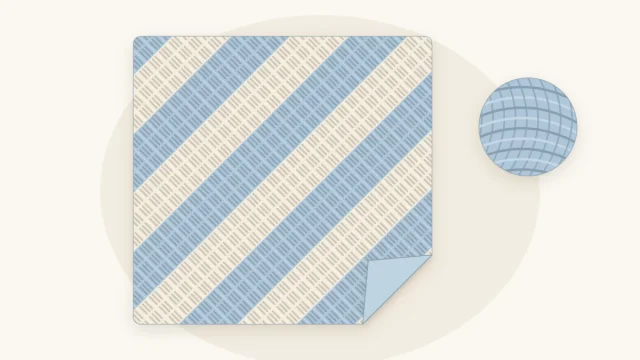
Stripes behave differently here than in plain rows. Each single crochet reaches down into the row below, so a new color dips into the old one and the line between two stripes is dotted instead of straight.
- Two-row stripes: every color change falls on the same edge. With two colors, the yarn not in use can be carried loosely up that edge instead of being cut, and a border worked later covers the carried strands.
- Three-row stripes: the bands are wider and the dotted line shows at each change. The changes alternate between the two edges, so cut the yarn each time and leave a 6 in (15 cm) tail.
To change color, work the last single crochet of the row until two loops remain on the hook, then finish the stitch with the new color. Chain 2 with the new color and turn. For the details, see how to change colors in crochet.
Finishing
Thread each tail onto the yarn needle and run it through the bases of the single crochets, changing direction at least twice so it locks. Avoid passing a tail straight across the chain spaces, where it can show. The steps are in the guide to weaving in ends.
A flat border evens out the sides. Work one round of single crochet: one stitch in each single crochet and each ch-1 space along the top and bottom, about one stitch per row end along the sides, and 3 stitches in each corner. If the sides ruffle, use fewer stitches; if they pull in, use more. The full method is in the article on a simple single crochet border.
Wash and dry the blanket as the yarn label directs. Afterward, look over both sides for any tail that has worked loose and weave it back in.
Frequently asked questions
Is moss stitch the same as linen stitch?
Yes. Moss stitch, linen stitch and granite stitch are three names for one crochet fabric: single crochets separated by single chains, with each stitch worked into the chain space of the row below. If a pattern uses any of these names with that repeat, the instructions are interchangeable.
Why does the pattern use a larger hook than plain single crochet?
Working into chain spaces pulls the rows close together, and the fabric can turn stiff at a small hook size. One size larger than you would use for plain single crochet in the same yarn usually keeps it flexible. Your swatch decides: change the hook until the fabric bends easily and matches the gauge.
My starting chain is an odd number. Can I still work the pattern?
Not without a leftover chain. With an odd number, Row 1 ends with one unused chain after the last skip instead of a single crochet. Pull out one chain or add one so the total is even, then start Row 1 again in the fourth chain from the hook.