Chevron Ripple Baby Blanket Pattern
A classic double crochet ripple in three colors, with a 12-stitch repeat, a clear dc3tog definition, and a stitch-by-stitch check showing why every row keeps the same count.
Tutorial at a glance
Materials
- Worsted weight (#4 medium) yarn in three colors, about 1,000-1,200 yd in total
- US H-8 (5 mm) crochet hook
- Blunt yarn needle
- Scissors
- Tape measure
- Stitch markers (optional)
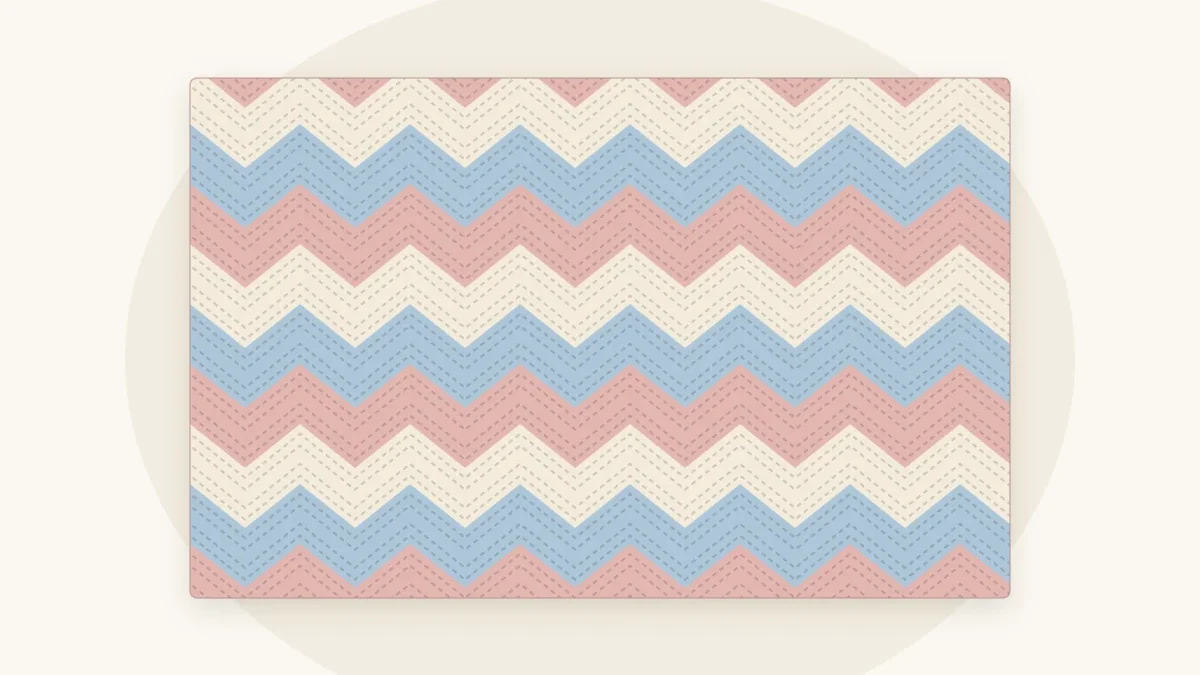
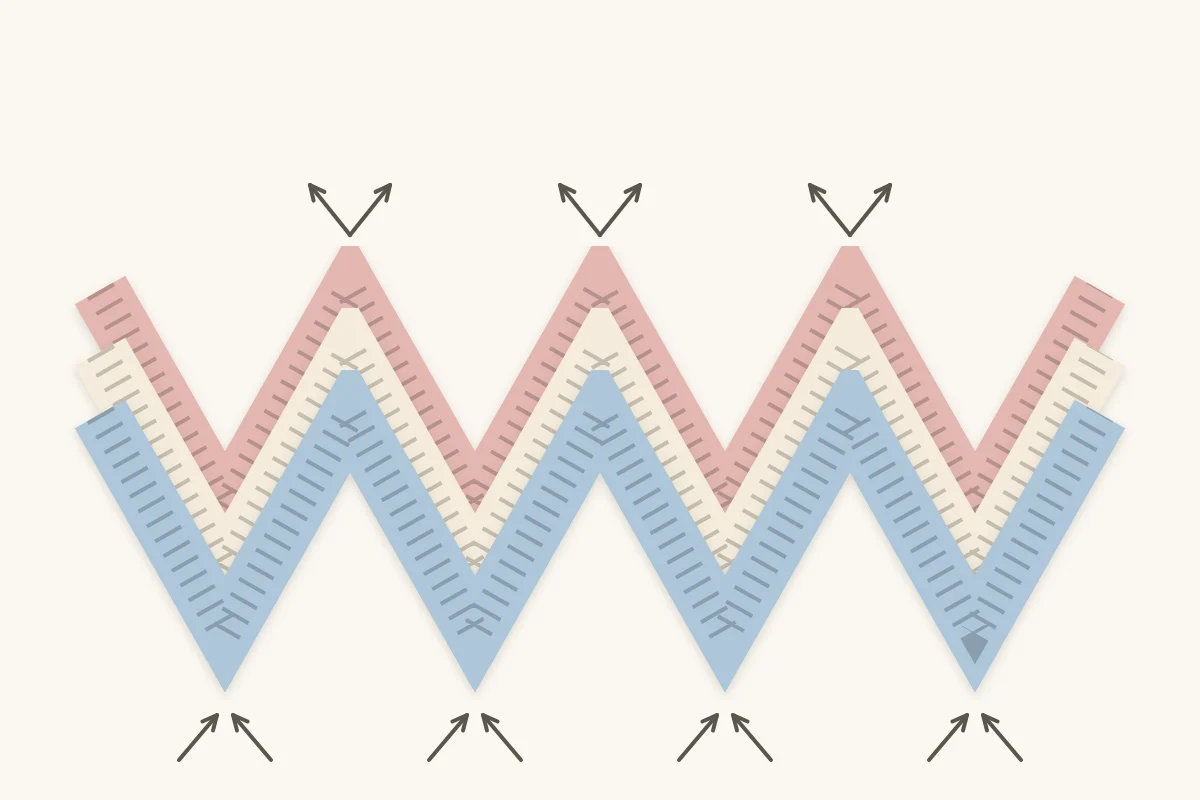
A chevron ripple baby blanket gets its zigzag from two moves repeated across every row: extra stitches worked into one place push the fabric up into a peak, and stitches joined together pull it down into a valley. Everything between is plain double crochet.
This classic ripple changes color every 2 rows. It suits an intermediate crocheter or a confident beginner who is comfortable with rows of double crochet. The pattern is written in US crochet terms.
Materials
- Worsted weight (#4 medium) yarn in three colors, about 1,000-1,200 yd (910-1,100 m) in total: Color A, Color B and Color C
- US H-8 (5 mm) crochet hook
- Blunt yarn needle
- Scissors and a tape measure
- Stitch markers (optional, for marking peaks)
Each color is about one third of the total, with slightly more of Color A. The amounts are estimates that depend on your gauge, so buy a little extra of each color from the same dye lot.
Finished Size
About 30 x 35.5 in (76 x 90 cm).
Gauge
One 12-stitch repeat = about 3 in (7.5 cm), measured straight across from peak to peak, and 7 rows = about 4 in (10 cm). Matching this target matters for the finished size and for how much yarn the blanket uses.
For a swatch, chain 27 and work 10 rows. That gives two repeats, about 6 in (15 cm) wide. See the guide to measuring crochet gauge if your swatch is off.
The chain follows from the gauge. Thirty inches at 3 in per repeat is 10 repeats. Each repeat needs 12 chains, so 10 x 12 = 120, plus 3: 123 chains.
Abbreviations
- ch – chain
- dc – double crochet
- st(s) – stitch(es)
- yo – yarn over
- dc3tog – double crochet 3 together: (yo, insert hook in next st, yo, pull up a loop, yo, pull through 2 loops) 3 times, which leaves 4 loops on the hook; yo and pull through all 4. Three stitches become one.
A dc2tog is the same decrease over two stitches. This pattern uses dc3tog only.
Pattern Notes
- The starting chain is a multiple of 12, plus 3. To change the width, add or remove chains in groups of 12.
- The turning ch-3 counts as a double crochet. The last stitches of every row go into the top of that chain.
- Every row has 121 stitches.
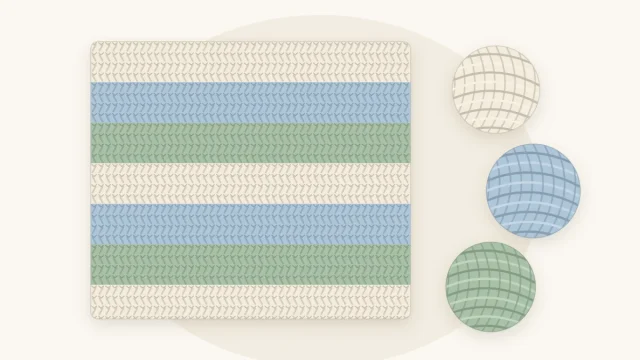
- Rows 1 and 2 use Color A, Rows 3 and 4 Color B, Rows 5 and 6 Color C, and so on in that order.
How Peaks and Valleys Balance
A peak is 3 dc worked into one stitch, a gain of 2. A valley is a dc3tog, a loss of 2. As long as a row gains as many stitches as it loses, its count does not change and the sides stay straight.
This blanket has 10 valleys, so each row loses 20 stitches. It has 9 full peaks, which add 18, and a half peak at each side edge, where 2 dc share one stitch and add 1 each. That is 20 gained and 20 lost, and the row stays at 121.
Instructions
With Color A, chain 123 loosely.
Row 1: 2 dc in the 4th ch from the hook (the 3 skipped chains count as the first dc). Dc in each of the next 3 ch, dc3tog over the next 3 ch. *Dc in each of the next 4 ch, 3 dc in next ch, dc in each of the next 4 ch, dc3tog over the next 3 ch; repeat from * until 5 chains remain. Dc in each of the next 4 ch, 2 dc in the last ch. (121 sts)
Row 2: Ch 3 (counts as first dc), turn. Dc in the first st, the same stitch the chain rises from. Dc in each of the next 4 sts, dc3tog over the next 3 sts. *Dc in each of the next 4 sts, 3 dc in next st, dc in each of the next 4 sts, dc3tog over the next 3 sts; repeat from * until 5 stitches remain, counting the turning chain as the last one. Dc in each of the next 4 sts, 2 dc in the top of the turning chain. (121 sts)
Rows 3-62: Repeat Row 2, changing color after every second row.
Fasten off, leaving a 6 in (15 cm) tail. The blanket has 31 stripes: 11 in Color A and 10 each in Colors B and C, beginning and ending with A.
Row 1 has 3 plain stitches before the first decrease and Row 2 has 4. That is not an error: the edge group is 3 stitches in Row 1 and 2 stitches in Row 2.
Check the Count on a Small Sample
Chain 27, the swatch size. Row 1: the skipped chains and 2 dc make 3 stitches, then 3 dc and one dc3tog, 7 stitches from 10 chains. One repeat makes 12 stitches from 12 chains. The last 5 chains take 4 dc and 2 dc, 6 stitches. The total is 7 + 12 + 6 = 25.
Row 2 makes 7 stitches over the first 8, 12 over the next 12, and 6 over the last 5: again 25, worked over 8 + 12 + 5 = 25. Row 3 is the same.
Tip
Place a stitch marker in the center stitch of each 3-dc peak. On the next row, the marked stitch is where the next 3 dc belong. The middle leg of each dc3tog goes into the dc3tog below.
Changing Color Every Two Rows
At the end of each even-numbered row, work the final dc until 2 loops remain on the hook, then pull the new color through both. Chain 3 with the new color and turn. Every change falls on the same side edge. See how to change colors in crochet for the details.
With three colors, each yarn waits 4 rows before its next turn, a long way to carry a strand up the edge. Cutting at each change and leaving a 6 in (15 cm) tail is neater. That makes 30 changes and 60 tails, so weave a few in after every stripe.
Finishing
Weave each tail into its own color along the stitch posts, changing direction at least twice. See how to weave in ends for the method.
The side edges of a ripple are straight, but the top and bottom stay zigzag. Squaring them means filling each valley with stitches of graded height, a separate technique this pattern does not use.
To flatten the peaks, follow the care label and see how to block a crochet blanket for the steps. After the first wash, check for any tail that has worked loose.
Frequently asked questions
Why is one side of my ripple blanket growing wider?
A row has more increases than decreases, or fewer. The usual causes are working 3 double crochets at the side edge where only 2 belong, or missing the final 2 stitches in the top of the turning chain. Count the row: any total other than the pattern's number means one of the edges needs checking.
Can I make the ripple blanket in one color?
Yes. The stitch pattern does not depend on the stripes, and a single color removes nearly all the tails. The zigzag is less obvious without color changes, so a light, solid yarn that shows the rows of stitches clearly gives the best view of the peaks and valleys.
How do I make the blanket wider or narrower?
Change the starting chain by 12 for each repeat you add or remove. At the stated gauge each repeat is about 3 inches wide, so a chain of 135 gives 11 repeats and roughly 33 inches. The row instructions stay the same; only the number of repeats and the stitch total change.