Granny Stripe Baby Blanket Pattern
Granny clusters worked in straight rows, with a checked chain multiple, cluster counts for each row, a four-color stripe plan and a practical way to handle the many yarn ends.
Tutorial at a glance
Materials
- Worsted weight (#4 medium) yarn in four colors, about 250-300 yd each
- US H-8 (5 mm) crochet hook
- Blunt yarn needle
- Scissors and tape measure
Granny stripe takes the three-stitch clusters of a granny square and works them back and forth in straight rows. There are no corners to turn and nothing to join: after one foundation row, every row is a line of clusters tucked into the gaps of the row below. It is one of the quickest ways to make a striped blanket.
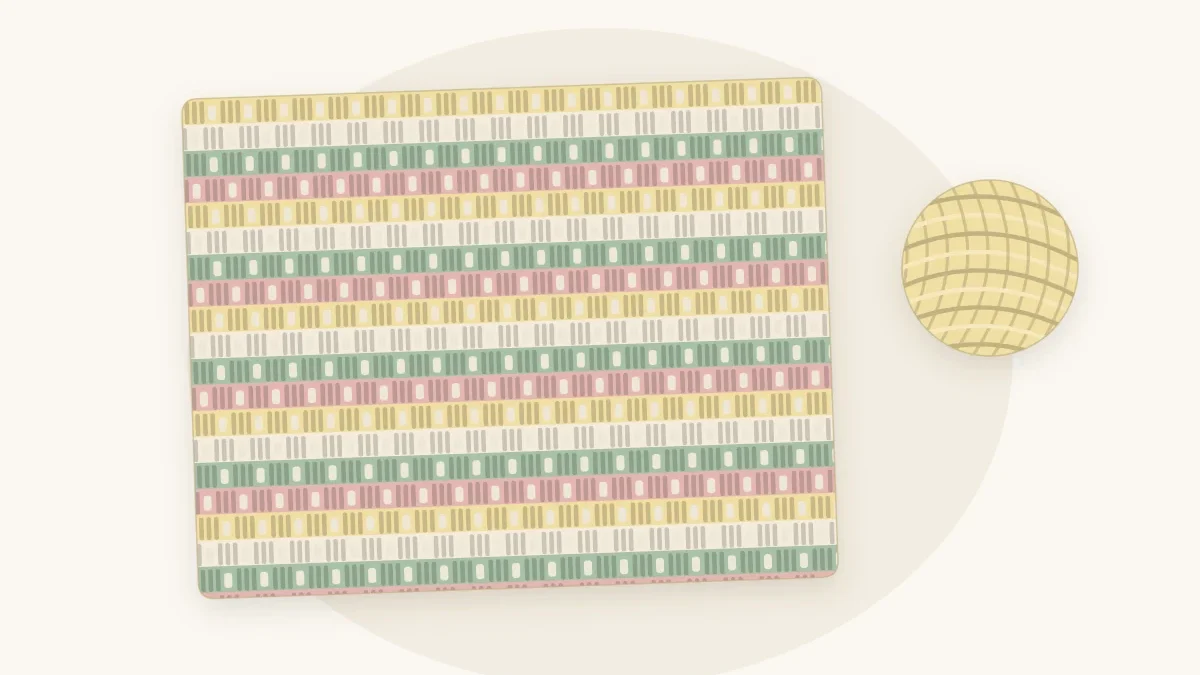
This granny stripe baby blanket uses four colors in two-row stripes. The fabric has small gaps between the clusters and drapes easily. The stitches are chain, single crochet and double crochet, so it suits anyone who has finished a basic double crochet blanket.
Materials
- Worsted weight (#4 medium) yarn in four colors (A butter, B cream, C sage, D dusty rose), about 250-300 yd (230-275 m) of each
- US H-8 (5 mm) crochet hook
- Blunt yarn needle
- Scissors and a tape measure
The total, about 1,000-1,200 yd (915-1,100 m), is an estimate that depends on gauge. Buy a little extra of each color from the same dye lot. DK (#3 light) yarn with a smaller hook also works, but you will need more clusters for the same width.
Finished Size and Gauge
About 30 x 36 in (76 x 91 cm) before any border.
Gauge target: 7 clusters = 6 in (15 cm) wide and 7 cluster rows = 4 in (10 cm) tall. Matching it matters for the finished size and the yarn amount. For a swatch, chain 32 and work 10 rows, then measure the gauge across the middle.
The chain count comes from the gauge. A width of 30 in divided by 6 in is 5, and 5 x 7 = 35 clusters. Each cluster needs 3 chains, so 35 x 3 = 105, plus 2 = 107 chains. For another width, chain any multiple of 3, plus 2.
Abbreviations
- ch = chain
- sc = single crochet
- dc = double crochet
- sk = skip
- sp = space
- st(s) = stitch(es)
Pattern Notes
- This pattern uses US crochet terms.
- The ch 1 at the start of Row 1 does not count as a stitch. The ch 3 at the start of every other row counts as the first dc.
- Cluster: 3 dc worked in the same stitch or space. From Row 3 on, clusters go into the gaps between the groups of the row below, not into the tops of stitches.
- In Rows 2 and 4, “first st” means the stitch at the base of the ch 3.
- Two kinds of row alternate. One has 35 full clusters with a single dc at each edge. The other has 34 full clusters with a 2-dc group at each edge. The edge stitches keep the sides straight.
Instructions
With A, ch 107.
Row 1 (foundation): Sc in 2nd ch from hook and in each ch across. (106 sc)
Row 2: Ch 3, turn, dc in first st, *sk 2 sts, 3 dc in next st; repeat from * to last 3 sts, sk 2 sts, 2 dc in last st. (34 clusters and a 2-dc group at each end; 106 dc)
Row 3: Ch 3, turn, 3 dc in each sp between groups across, dc in top of ch 3. (35 clusters and 1 dc at each end; 107 dc)
Row 4: Ch 3, turn, dc in first st, 3 dc in each sp between clusters across, 2 dc in top of ch 3. (34 clusters and a 2-dc group at each end; 106 dc)
Repeat Rows 3 and 4 until the blanket measures about 36 in (91 cm), ending after a Row 3. At the target gauge that is about 62 cluster rows.
In Row 3, the first cluster goes into the gap between the 2-dc edge group and the first full cluster, and the last cluster goes into the gap before the 2-dc group at the far end. In Row 4, the narrow gap between the single edge dc and its neighboring cluster is left empty at both ends, because the edge stitches go into the edge dc itself.
Tip
Count clusters, not stitches. Every Row 3 has 35, and every even-numbered row has 34 plus the two edge groups. If a row is one cluster short, a gap was skipped, usually the first or the last.
Stripe Plan
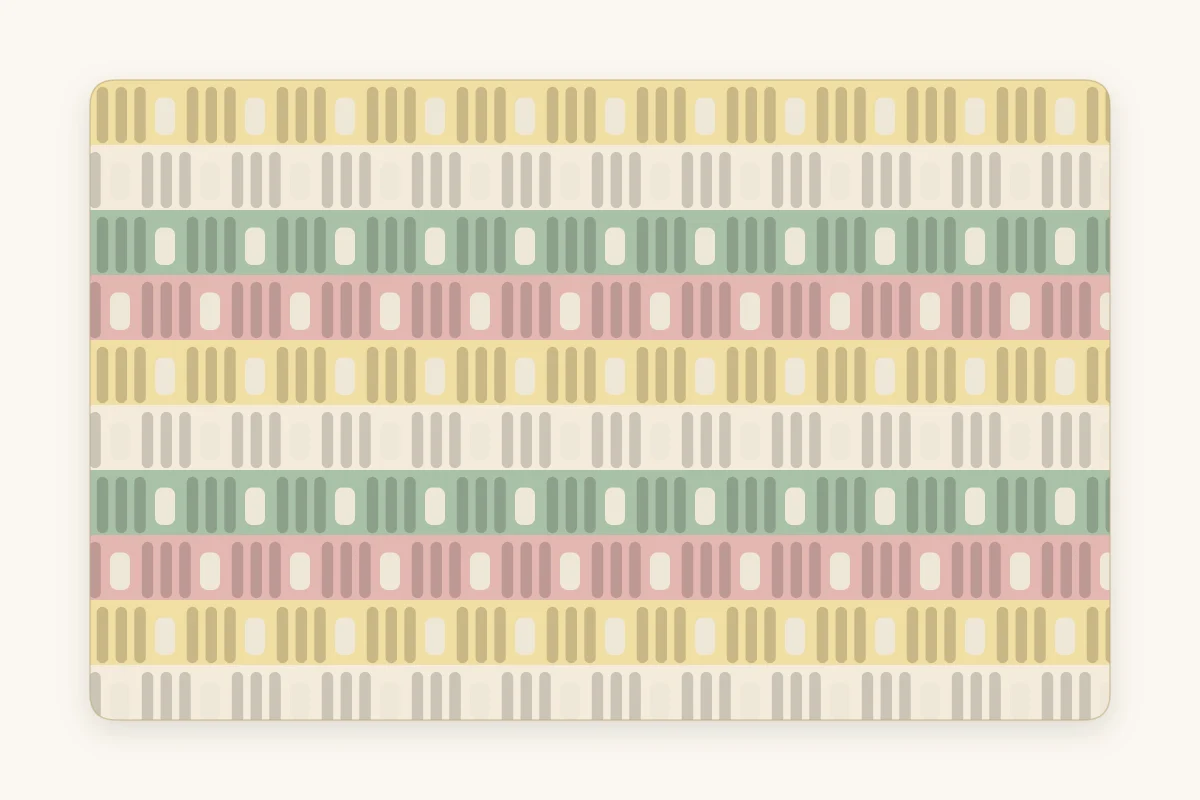
Work the foundation row and the first stripe (Rows 2 and 3) in A. After that, change color every two rows in the order B, C, D, A. With two-row stripes, every change falls at the same edge, at the end of a Row 3.
To change, work the last dc of the row until 2 loops remain on the hook, then finish the stitch with the new color. Ch 3 with the new color, turn and carry on. The method is shown step by step in how to change colors in crochet.
Sixty-two cluster rows make 31 stripes: 8 each of A, B and C and 7 of D, so the blanket begins and ends with different colors. For one-row stripes, change color at the end of every row; the changes then alternate between the two edges, and the number of tails doubles.
Managing the Ends
With four colors, six rows pass before a color returns, which is too far to carry yarn up the side. Cut each color, leaving a 6 in (15 cm) tail. That makes about 60 tails over the blanket.
You can deal with half the work as you go. Lay the two tails along the top of the row below and work the first three or four clusters of the new row over them, so the stitches wrap around the tails. Then thread each tail on a needle and run it back through the bases of those clusters in the opposite direction before trimming. A tail that only travels one way can work loose in the wash.
Watch out
Keep tails inside the solid clusters. A tail carried across an open gap shows on both sides, especially when it is darker than the stripe around it.
Finishing
Fasten off after the last row. Go over the whole blanket for missed tails and secure each one as described in how to weave in ends.
The side edges show a color change every two rows. One or two rounds of single crochet in a single color cover those changes and give all four sides the same finish; the simple border instructions explain how to space stitches along the row ends and keep the edge flat.
Frequently asked questions
How many chains do I need to start a granny stripe blanket?
For this version, chain a multiple of 3, plus 2. Each cluster takes up three chains, and the two extra chains cover the edge stitch and the turn. To plan a width, swatch, count how many clusters fit in your target width, multiply that number by 3 and add 2.
Why does my granny stripe blanket have slanted or wavy sides?
The edge stitches are being missed or doubled. One kind of row ends with a single double crochet in the top of the turning chain; the other begins with a double crochet in the first stitch and ends with two in the turning chain. If the rows do not alternate, the sides drift.
Can I make a granny stripe blanket in one color?
Yes. The row instructions are identical; simply do not change yarn. A single color shows the cluster texture clearly and leaves only a few tails to weave in, one pair for each new ball of yarn. A long color-changing yarn gives stripes without cutting, though the stripe widths will be irregular.