Giant Granny Square Baby Blanket (One Continuous Square)
Crochet one large granny square in rounds until it reaches blanket size. Exact first rounds, a rule for every later round, and how to stop the square from twisting.
Tutorial at a glance
Materials
- Worsted weight (#4 medium) yarn, about 1,000-1,200 yd in total
- US H-8 (5 mm) crochet hook
- Blunt yarn needle
- Scissors and tape measure
- Locking stitch marker (optional)
If you like the look of granny clusters but not the idea of sewing thirty squares together, make one square and keep going. A giant granny square baby blanket starts as an ordinary square and grows by one round at a time until it is as wide as you want. There is no seaming at all, because the blanket is a single piece from the first chain to the last stitch.
The only stitches are chain, slip stitch and double crochet. The one real trap is that a large granny square worked always in the same direction slowly twists into a pinwheel. This pattern avoids that by turning the work after every round.
Materials
- Worsted weight (#4 medium) yarn, about 1,000-1,200 yd (915-1,100 m) in total, in one color or several
- US H-8 (5 mm) crochet hook
- Blunt yarn needle
- Scissors and a tape measure
- Locking stitch marker (optional)
The yardage is an estimate that depends on gauge. Buy a little extra from the same dye lot. Because you can stop after any round, this is a forgiving project when the amount of yarn is uncertain.
Finished Size and Gauge
About 35 x 35 in (89 x 89 cm), in about 28 rounds.
Gauge target: Rounds 1 to 4 = 5 in (12.5 cm) across, measured side to side, with each later round adding about 1.25 in (3 cm) to the width. Matching it matters for the number of rounds and for the yarn amount. The first four rounds are your swatch; if they measure well under or over 5 in, change hook size and start again. See the gauge guide for measuring tips.
Abbreviations
- ch = chain
- dc = double crochet
- sl st = slip stitch
- sp = space
Pattern Notes
- This pattern uses US crochet terms.
- The ch 3 at the start of each round counts as the first dc.
- Cluster: 3 dc in the same space. Corner: (3 dc, ch 2, 3 dc) in the same ch-2 space.
- Join every round with a sl st in the top of the ch 3, then turn the work so the other side faces you. Each round travels in the opposite direction to the one before, which cancels the slight lean of the stitches and keeps the square from spiraling.
- Because of the turns, both sides of the blanket look the same.
Instructions
Ch 4 and join with a sl st in the first ch to form a ring.
Round 1: Ch 3, 2 dc in ring, ch 2, *3 dc in ring, ch 2; repeat from * 2 more times, join. (4 clusters, 12 dc)
Round 2: Turn. Sl st into the ch-2 sp you just made, which is now the first space. Ch 3, (2 dc, ch 2, 3 dc) in same sp, *ch 1, (3 dc, ch 2, 3 dc) in next ch-2 sp; repeat from * 2 more times, ch 1, join. (8 clusters, 24 dc)
Round 3: Turn. Sl st into the ch-1 sp you just made. Ch 3, 2 dc in same sp, ch 1, *(3 dc, ch 2, 3 dc) in next ch-2 sp, ch 1, 3 dc in next ch-1 sp, ch 1; repeat from * 2 more times, (3 dc, ch 2, 3 dc) in last ch-2 sp, ch 1, join. (12 clusters, 36 dc)
Round 4 and every later round: Turn. Sl st into the ch-1 sp you just made, ch 3, 2 dc in same sp, ch 1. Work around the square, placing 3 dc in each ch-1 sp and (3 dc, ch 2, 3 dc) in each ch-2 corner sp, with ch 1 after every cluster and every corner. Join.
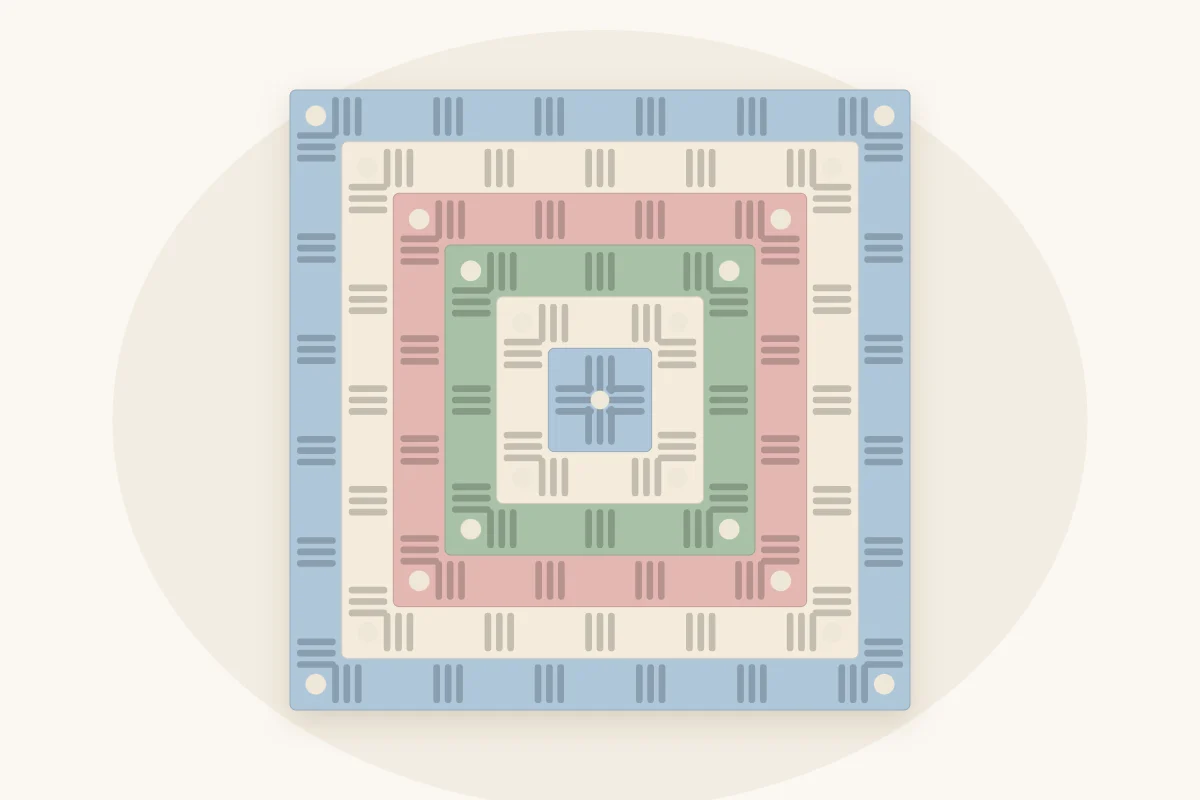
The Rule for Any Round
From Round 2 onward, round N has 4 corners and N – 2 side clusters between each pair of corners. Counting the two halves of each corner as clusters, that is 4 x N clusters and 12 x N double crochets. Round 4 has 2 side clusters per side and 16 clusters in all; Round 10 has 8 per side and 40 in all.
You do not need to count a whole round. Count the side clusters on one side between two corners and compare with the round number minus 2. If all four sides agree, the round is right.
Watch out
The cluster most often missed is the last one of the round, in the space just before the starting ch 3. Check that the round ends with a cluster and ch 1 beside the start, not with a corner followed directly by the join.
Changing Colors
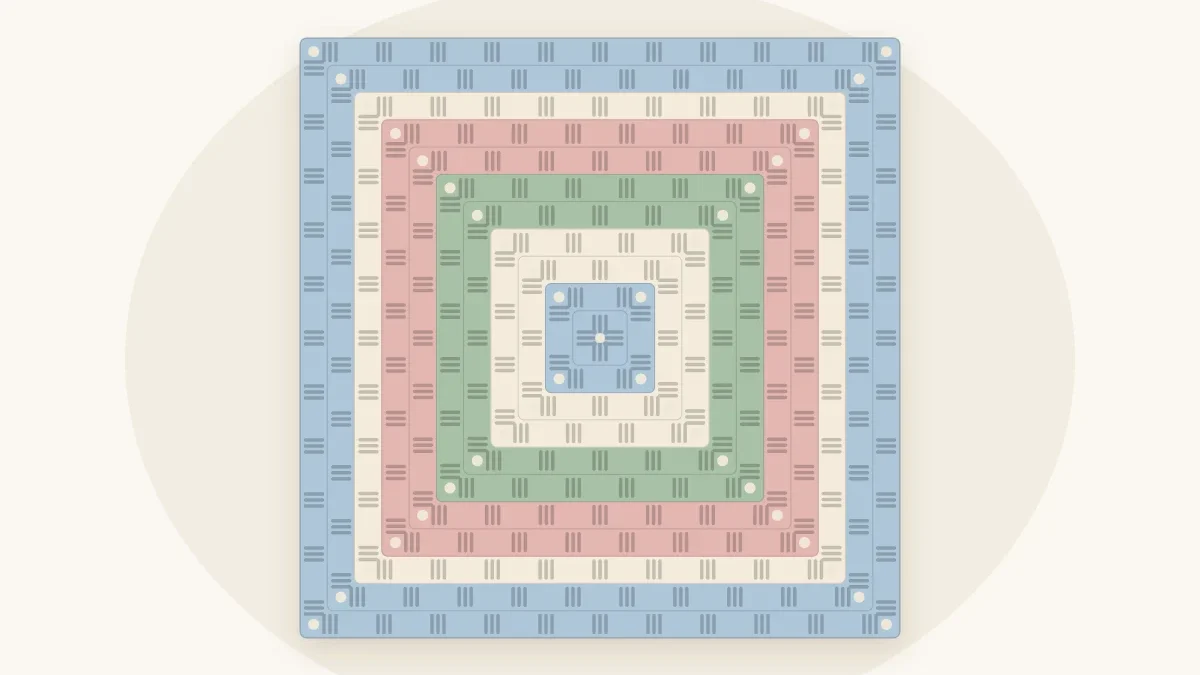
Change color after any round. Fasten off, turn, and join the new color with a sl st in any corner space. Ch 3, (2 dc, ch 2, 3 dc) in that space, ch 1, then follow the rule for every later round. Starting in a different corner each time spreads the joins around the blanket. The steps for a tidy join are in how to change colors in crochet.
Bands of equal width do not use equal amounts of yarn. In a 28-round blanket with four bands of seven rounds, the center band takes about 7 percent of the stitches, the second about 19 percent, the third about 31 percent and the outer band about 43 percent. Give the color you have most of the outside position.
Knowing When to Stop
Stop when the square measures the size you want, allowing for the border. Common sizes are listed in the baby blanket size chart.
Each round has 12 more double crochets than the one before, so yarn use climbs steadily. Round 20 takes twice as much as Round 10, and the last five rounds of a 28-round blanket hold about a third of all its stitches. Never assume a leftover ball will cover one more round.
Tip
A kitchen scale answers the question. Weigh the blanket before and after a round to find what that round used. The next round needs slightly more. If the yarn you have left weighs less than that, stop here and keep the remainder for the border.
Finishing
Fasten off and weave in every end, following the posts of the clusters so tails do not cross an open space. Block the square with the corners pinned out so the sides run straight, using a method that suits the care label.
The last round already makes a neat edge. For a firmer one, add a round of single crochet with 3 stitches in each corner space, as described in the simple border instructions, and keep it flat.
Frequently asked questions
Why is my big granny square twisting?
Double crochet stitches lean slightly in the direction you work. When every round goes the same way, the lean adds up and the corners drift into a pinwheel. Turning the work after each joined round reverses the direction, so the lean of one round is balanced by the next.
How many rounds does a giant granny square baby blanket need?
It depends on your yarn, hook and tension, so measure instead of counting. At the gauge in this pattern, about 28 rounds make roughly 35 in. Lay the square flat, measure from side to side through the center, and stop when it reaches the width you planned.
Why are the sides of my granny square ruffling?
Ruffled sides usually mean an extra cluster or extra chains have crept in. Count the side clusters on each side: there should be two fewer than the round number. Rippling on a correct count can also come from loose chains between clusters, which a smaller hook or firmer tension will settle.